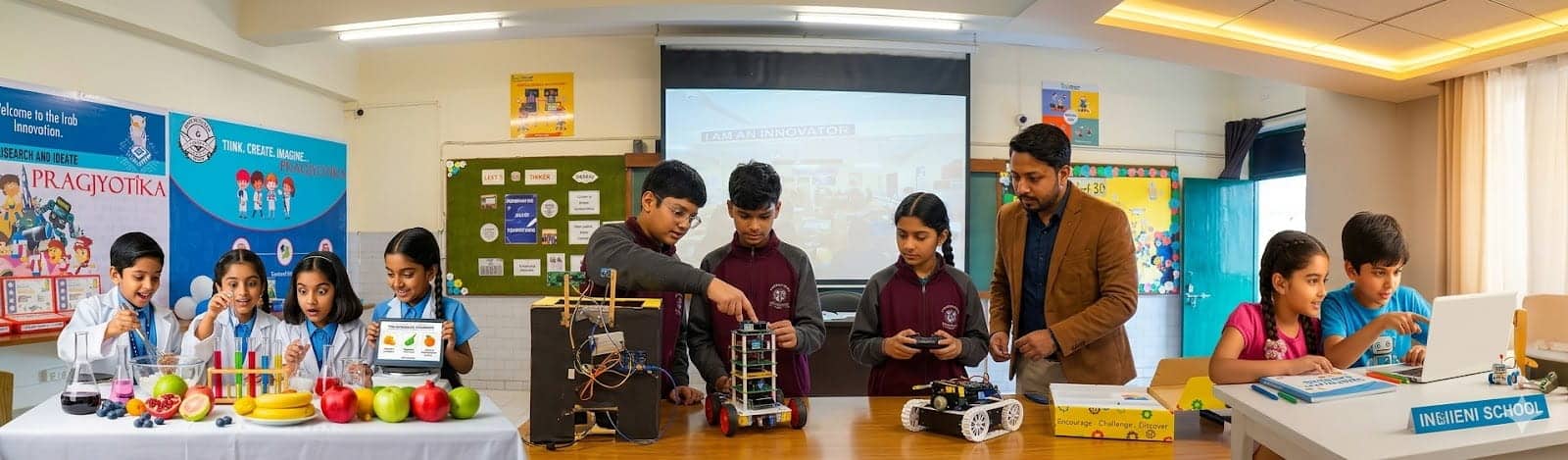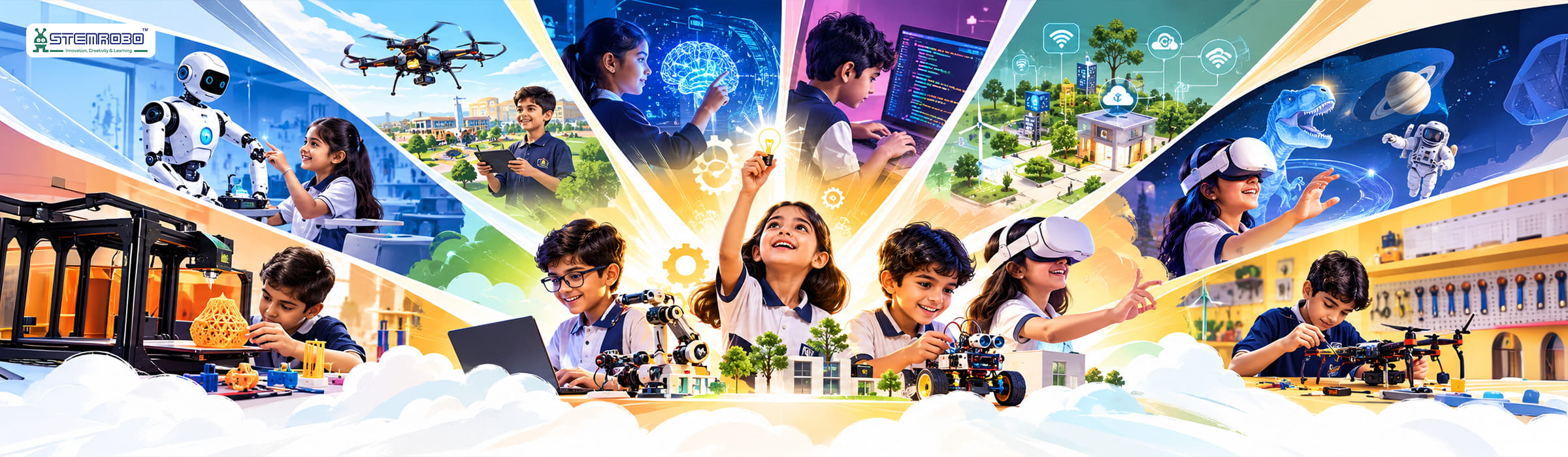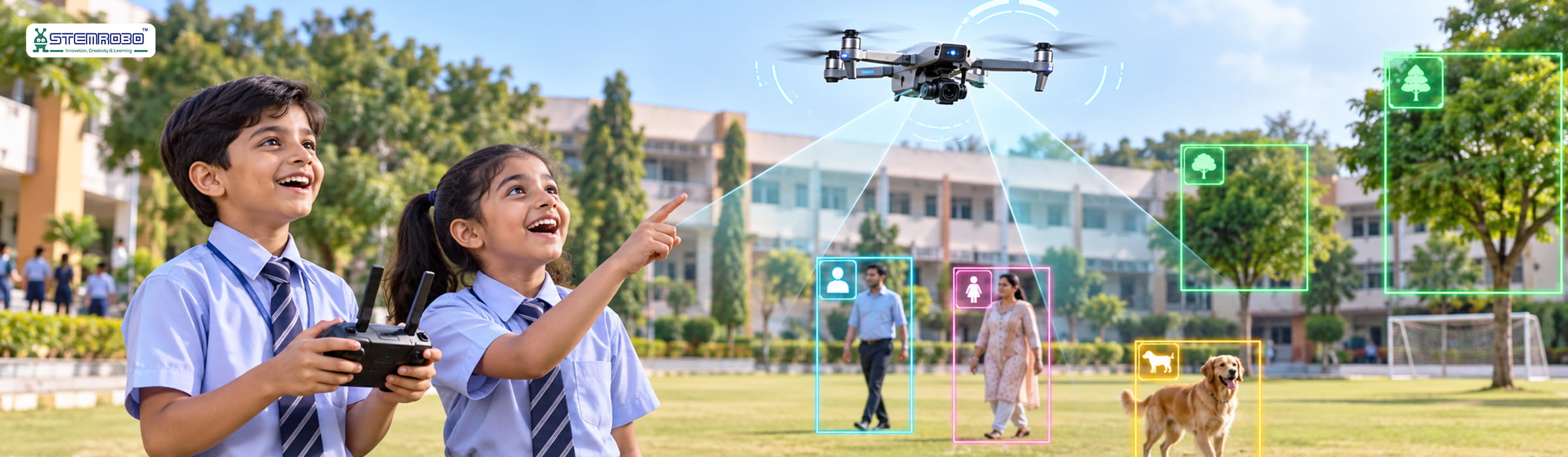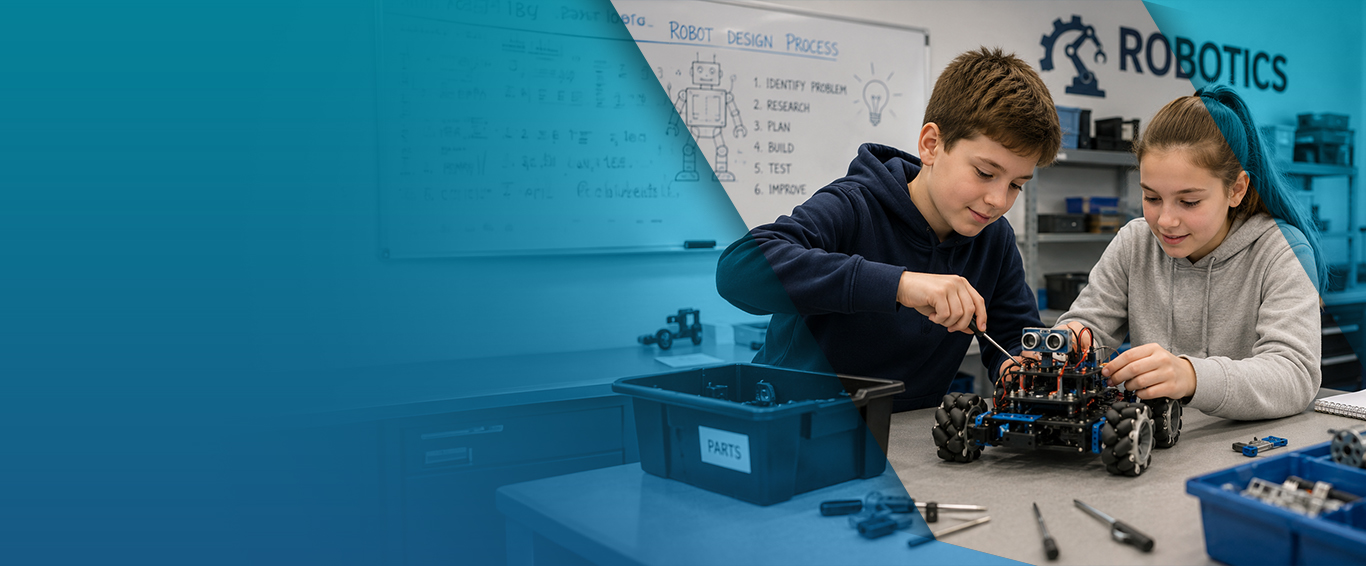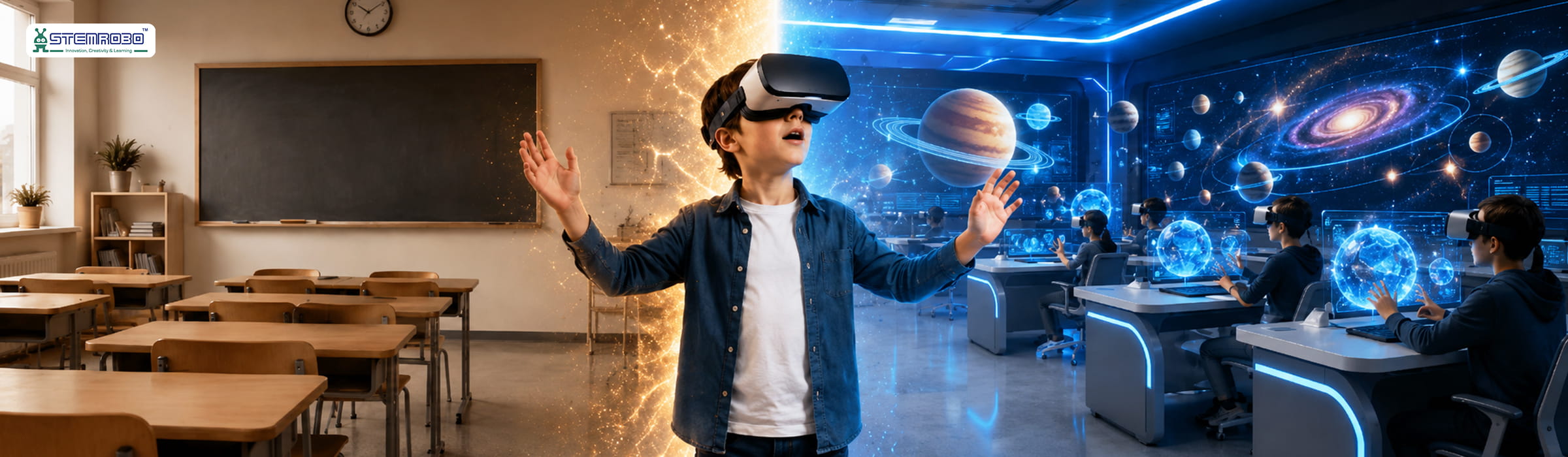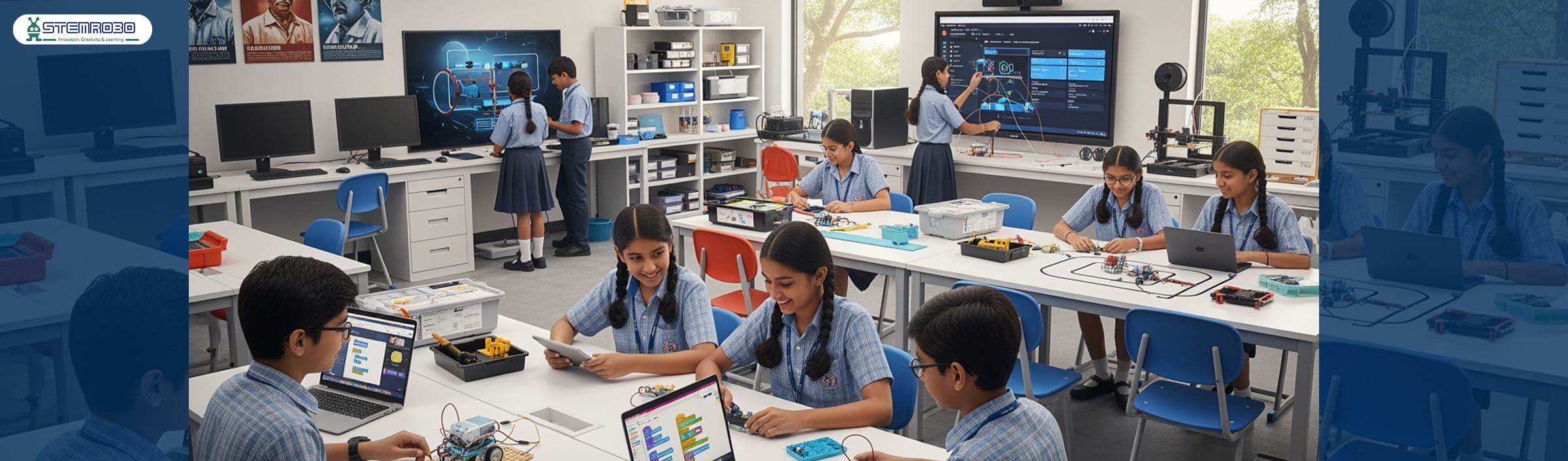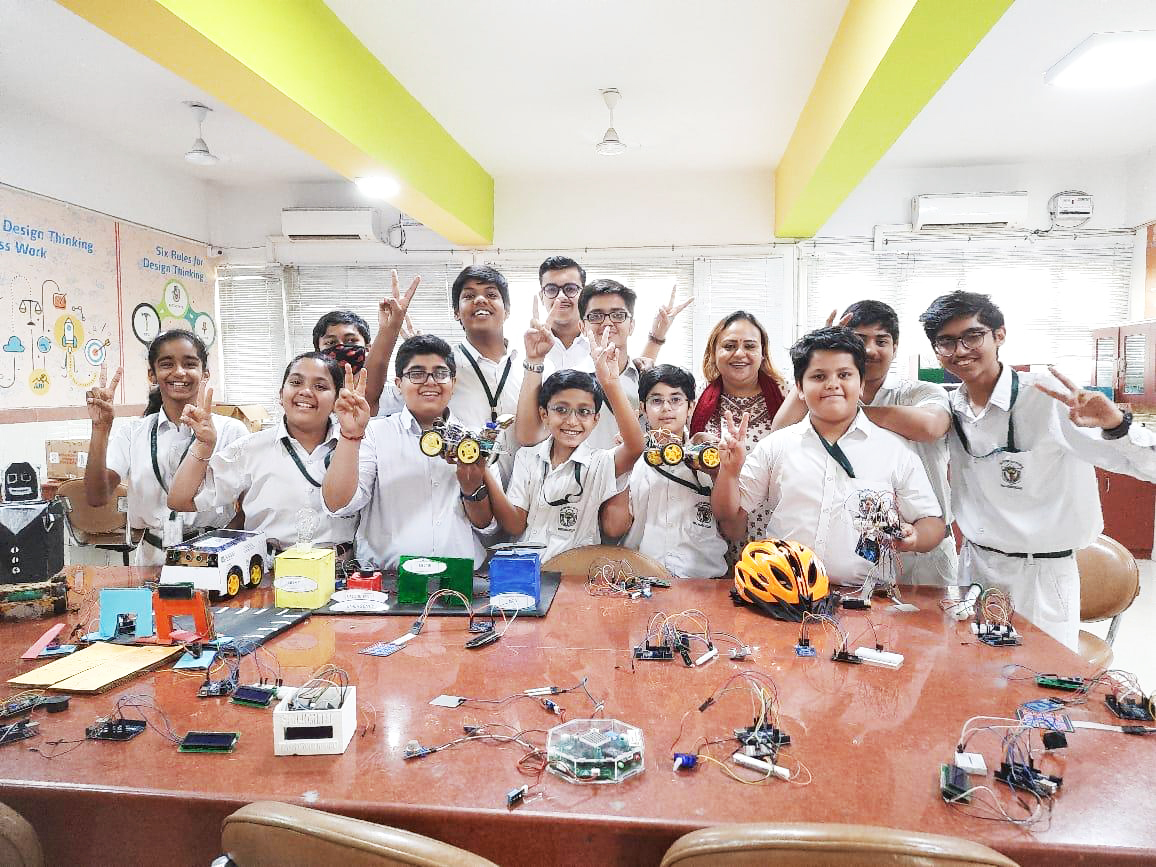
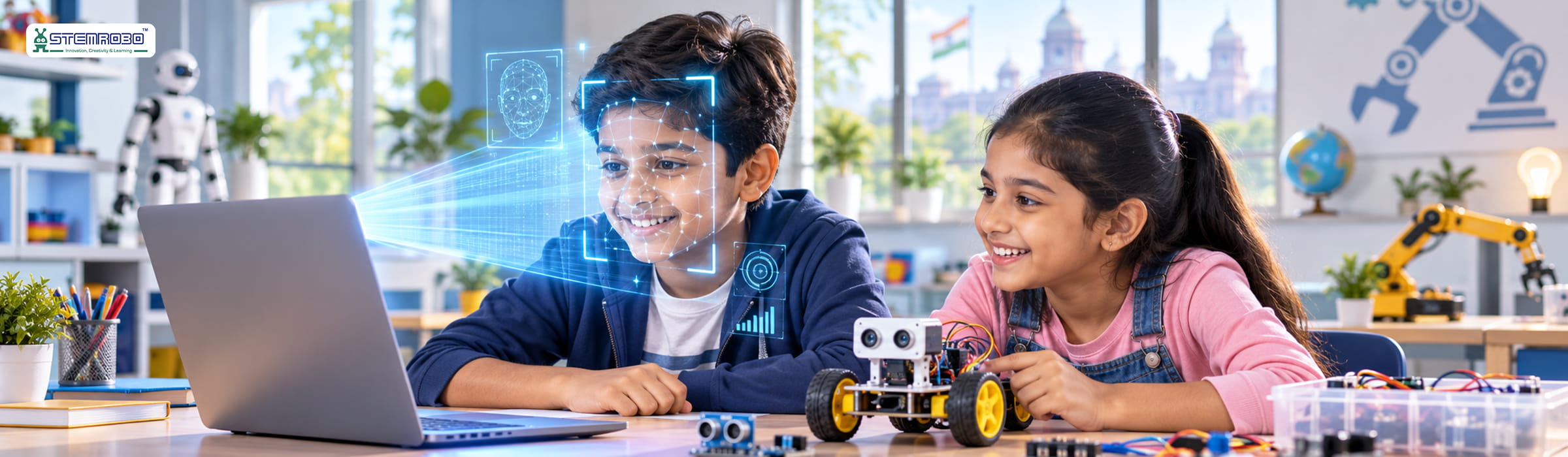
The Indian classroom is undergoing a makeover. Students are slowly moving away from book and lecture-style education, and embracing hands-on, technology-enabled learning. One reason for this transformation has been the increasing integration of AI and Robotics education in schools in India.
They are being brought to the students via STEM education, coding education and learning by doing and designing to tackle everyday real-world issues and prepare them for a future landscape.
And there is a policy push to this drive as well;Coding,computational thinking, Digital Literacy,problem solving,innovation;and new age areas like Artificial Intelligence are all part of the crucial segments under NEP 2020.
Definition: AI and Robotics Education
AI and Robotics Education is a form of education which seeks to teach students about Artificial Intelligence, robotics, programming, electronics, computation, and automation using age-appropriate exercises and projects.
Why Is AI and Robotics Education Growing in Indian Schools?
Growing demand for AI education in India is fueled up with evolving education policies, digital transformation and needs of the learners.
The NEP 2020 and National Curriculum Framework for School Education 2023 stresses on concepts like Critical thinking, Creativity, Interdisciplinary learning, vocational training, digital literacy, programming, computational thinking and emerging technologies like Artificial Intelligence.
CBSE continues its stride on technology education by proposing a new framework with Computational Thinking and Artificial Intelligence Framework for Classes III-VIII (2026-27) while keeping Artificial Intelligence as a skill subject at secondary and senior secondary level.
In other words, AI-based education is increasingly turning out to be an element of an organized schooling system rather than just an extracurricular activity.
How AI and Robotics Education Is Transforming Indian Schools
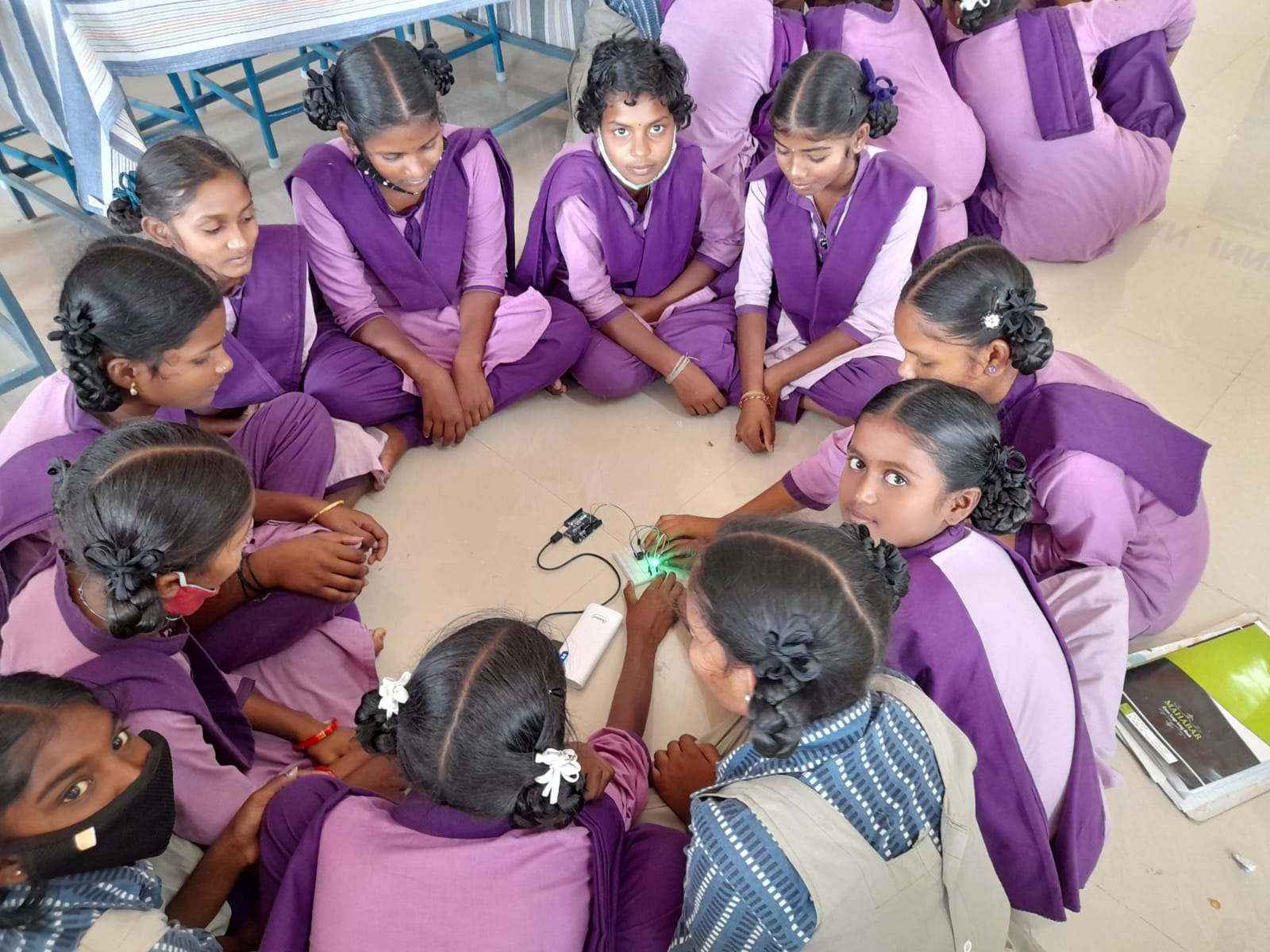
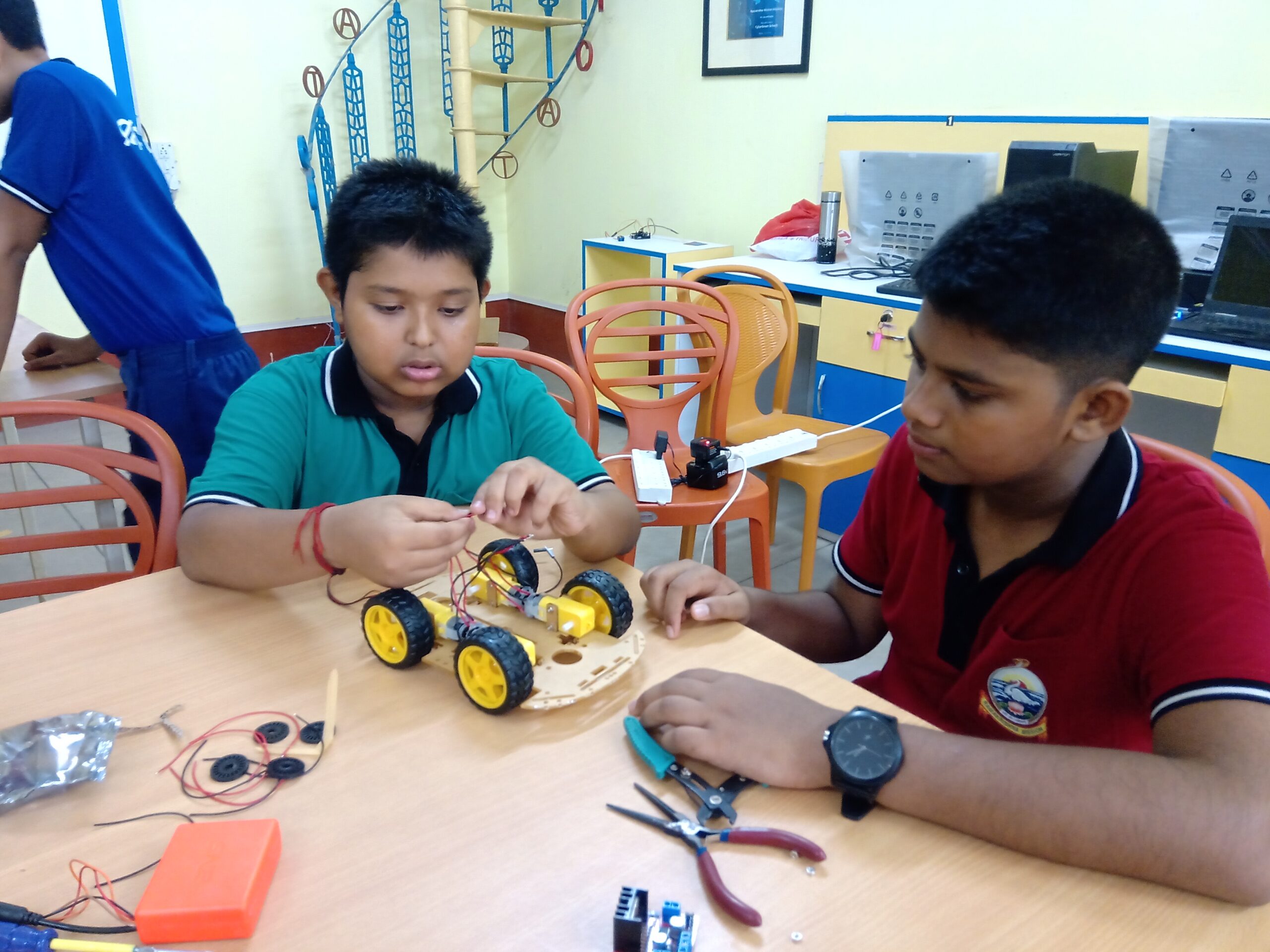
1. Transition from Learning Theory to Applied Learning : AI and robotics are shifting classrooms from learning about technology to learning through technology. Students can create intelligent irrigation systems, robots, waste management solutions, and AI projects making things practical and more fun.
2. Building Future-Ready Skills Through AI and Robotics: The learning on the course is more than theory. It involves practical work where you will develop skills on: critical thinking, creativity, problem-solving, working together, communicating with others, computational thinking, and digital knowledge. So the question being raised will be more of: “what have you learned?”, rather than “how will you use what you’ve learned?”
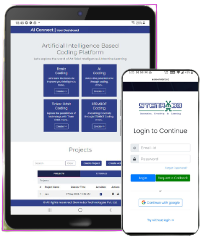
3.How Coding Education Builds Creativity: Coding offers kids a chance to think of their solutions. Beginners can learn to use sequences, loops, conditionals, and algorithms through visual programming. Then the learners get introduced to programming languages such as Python through platforms like STEMROBO AI Connect that provide the opportunity for learning programming via Python block coding and block to text code conversion.
What Are the Benefits of AI and Robotics Education for Students?
AI and robotics education helps students develop both technical and transferable skills that extend beyond the classroom.
- Enhanced Problem-Solving Skills
- Computational Thinking
- Innovation and Creativity
- Critical Thinking
- STEM Education
- Collaboration and Communication
- Digital Literacy
- Career Exposure
What Role Does Robotics Play in STEM Education in India?
Robotics involves many disciplines.
A student working on a robot could be using:
- Electronics
- Sensors
- Programming
- Data
- Engineering
- Design Thinking
An example of such learning philosophy is Atal Innovation Mission’s Atal Tinkering Labs (ATL). AIM claims 10,000 ATLs in 35 States and UTs in India spread across 722 districts that have involved more than 1.1 crore students and generated more than 16 lakh+ innovation projects.
These labs provide exposure to technologies like robotics, IoT, 3D Printing, Electronics and Physical Computing.
Traditional vs AI & Robotics- Enabled Learning
| Traditional Approach | AI & Robotics-Enabled Approach |
| Teacher-led instruction | Teacher-guided exploration |
| Textbook-focused | Project-focused |
| Memorisation | Conceptual understanding |
| Fixed answers | Multiple possible solutions |
| Theory-first | Theory + experimentation |
| Individual assignments | Collaborative projects |
| Limited prototyping | Build-test-improve cycles |
| Periodic assessment | Continuous project-based assessment |
| Subject-specific learning | Interdisciplinary learning |
| Technology as a topic | Technology as a creation tool |
The objective is not to replace conventional education.
Instead, technology can strengthen traditional subjects by giving students opportunities to apply what they learn.
What Is the Role of Teachers in AI and Robotics Education?
The use of technology by itself cannot bring about change in a classroom.
Teachers can.
That’s precisely why teacher training is such an important aspect of successful technology integration.
The 2026 training program of CIET-NCERT on Robotics and Artificial Intelligence in Education had its specific focus on helping teachers create hands-on learning, competency-based learning around robotics, AI, IoT and Machine Learning.
An effective school implementation strategy must, therefore, have:
- Teacher Orientation
- Technology Training
- Curriculum Alignment
- Lesson Plans
- Guided Projects
- Assessment
- Mentoring
- Exhibitions/Competitions
How Can Schools Successfully Implement AI and Robotics Education?
Schools can implement AI and Robotics Education through a structured, grade-wise, and phased approach.
- Learning Outcomes: Coding, AI, robotics, computational thinking and innovation.
- Grade-wise Curriculum: Grades begin with coding and logic, after which the student learns robotics, IOT, AI, python, project work, etc
- Hands-on Learning: Robot kit, sensors, microcontroller, AI resources, coding application, and other equipment to be used during projects.
- Teacher – Training: The teachers should be well trained and equipped.
- Project Based Learning: Connect learning to problem-solving in the real world with projects.
- Innovation Culture: Encourage innovation culture among students by way of exhibition, competition and innovation challenges.
What Does a Future-Ready Indian School Look Like?
Future school is not merely a school equipped with computers.
It is a school that integrates AI, robotics, coding, STEM learning, and emerging technologies into its learning ecosystem.
Curriculum + Teachers + Technology + Projects + Assessment + Mentoring
Example could be:
Learn → Build → Test → Improve → Present
Thus, the framework may help in converting the classroom from being an environment of gaining knowledge into one where students build solutions to challenges faced by them.
How Much Does AI and Robotics Education Cost for Schools?
There isn’t any fixed cost associated with introducing AI & Robotics education in schools.
Some of the parameters affecting the cost are:
- Number of students
- Number of grades
- Hardware
- Duration of curriculum
- Teachers’ training
- Infrastructure
- Software
- LMS
- Number of teachers
- Yearly maintenance & support
Hence, rather than comparing vendors based on their cost of hardware, schools need to look at the whole education solution they provide.
Schools must consider all aspects of the solution; not just the hardware costs but include the curriculum, teacher training, support for implementation and ongoing learning outcomes.
Why Schools Should Start AI and Robotics Education Now
What is the current issue facing schools?
The question is not: “Should we adopt AI and Robotics?”
The question that must be asked is: “How should we adopt them?”
“India’s school education ecosystem is already moving toward AI readiness, computational thinking, experiential learning, and technology-enabled education.”
In the CBSE 2026-27 curriculum, Computational Thinking and AI will be included for Classes III-VIII, while AI remains as the skill subject in all secondary and senior-secondary streams.
The Atal Tinkering Lab Ecosystem is working on laying down a mass base for experiential innovation. And the emphasis on critical thinking, creativity, multidisciplinary learning, vocational exposure, and technology-enabled education is increasing in the national curriculum framework.
The opportunity for school leaders here is to go past just adding one technology period to the timetable.
How STEMROBO Supports AI and Robotics Education in Schools
STEMROBO offers K-12 solutions in AI, Robotics, IoT, Coding, STEM, AR & VR, and other advanced technologies to help schools create a structured experience aligned with 21st century skills and NEP 2020.
Schools can explore:
- AI & Robotics Education Solutions
- STEMROBO School Solutions
- Educator Training Programs
- STEM Learning Management System
- AI Connect Learning Platform
Conclusion
Introducing AI & robotics in schools is all set to reshape the Indian education and mode of learning which will shift from books to practical work utilizing attained knowledge. It will let students have hands-on problems on ways and how they enhance the capabilities of problem solving, unleash creativity, foster skills to reason with and also the ones to work as a team related to the computational concepts behind AI and robotics.
The times where India is entering into a zone of creating innovations would also lead in teaching children of AI & robotics will also prove to give their students an opportunity of contributing their best in the making of the future.
Frequently Asked Questions
1. What is AI and Robotics Education in schools?
AI and Robotics Education refers to introducing Artificial Intelligence, robotics, coding, electronics, computational thinking, and automation to students through proper education and activities.
2. Why should schools teach AI and robotics?
The inclusion of the teaching of AI and robotics enables students to utilize theoretical knowledge in practice in problem-solving, computational thinking, creative thinking, collaborating thinking and digital technology skills.
3. At what age should students start learning AI and robotics?
Computational thinking, coding, and technology can be taught to the students from primary and middle classes whereas advanced subjects such as AI, robotics, and programming can be taught gradually as the students become secondary and senior-secondary students.
4. Is AI included in the CBSE curriculum?
Yes, AI was included in the skill subjects by CBSE, and in 2026-27, CBSE released a curriculum framework on Computational Thinking & AI for classes III-VIII.
5. Does robotics education require advanced coding knowledge?
No. Block based coding, like block based coding, can be introduced by level to learn coding from scratch, in other languages from python etc. The learning of block coding should be based on the student age.
6. Can AI and robotics be integrated with regular subjects?
Yes. AI and robotics could be introduced to science, mathematics, environment, computer science or any other academic subjects through projects.
7. What equipment is required for a school robotics program?
According to the grade and the expected results, we will need robotics kits, sensors, controllers, electronics, computers and coding software, IOT hardware, etc.
8. Do teachers need technical backgrounds?
Certainly not. Teachers can gain all the required technical skills through training programs.
9. How can a school start an AI and robotics program?
The schools can adopt AI & Robotics Education by establishing a curriculum; providing teachers with appropriate training; offering materials for hands-on practice as well as project-based work. Collaborative efforts with a trusted ed-tech institution could also be useful.