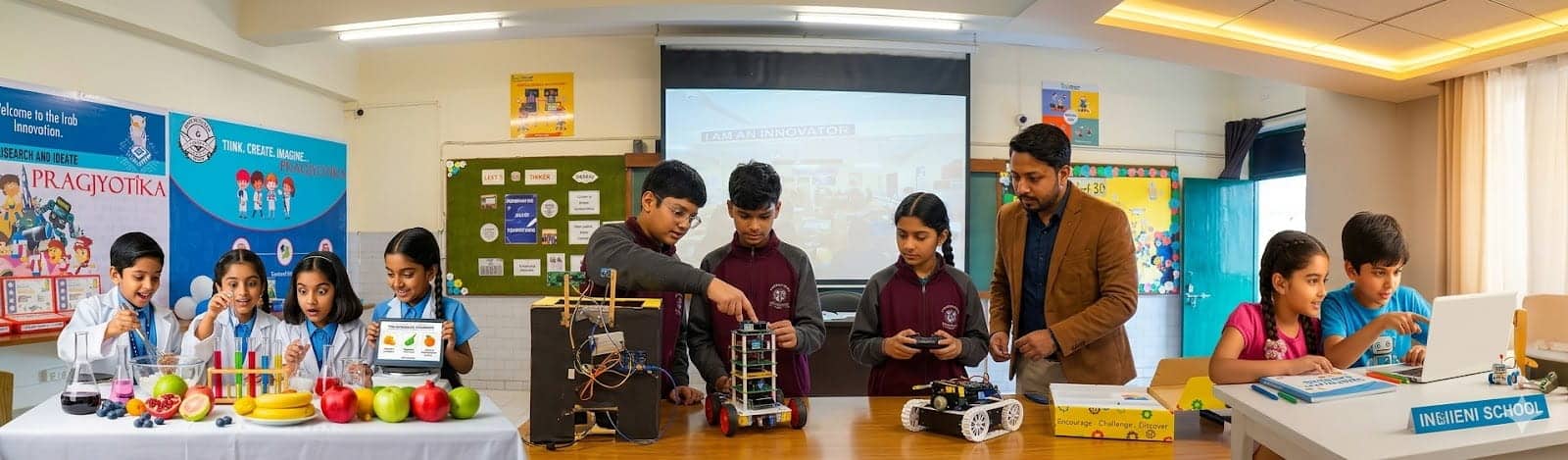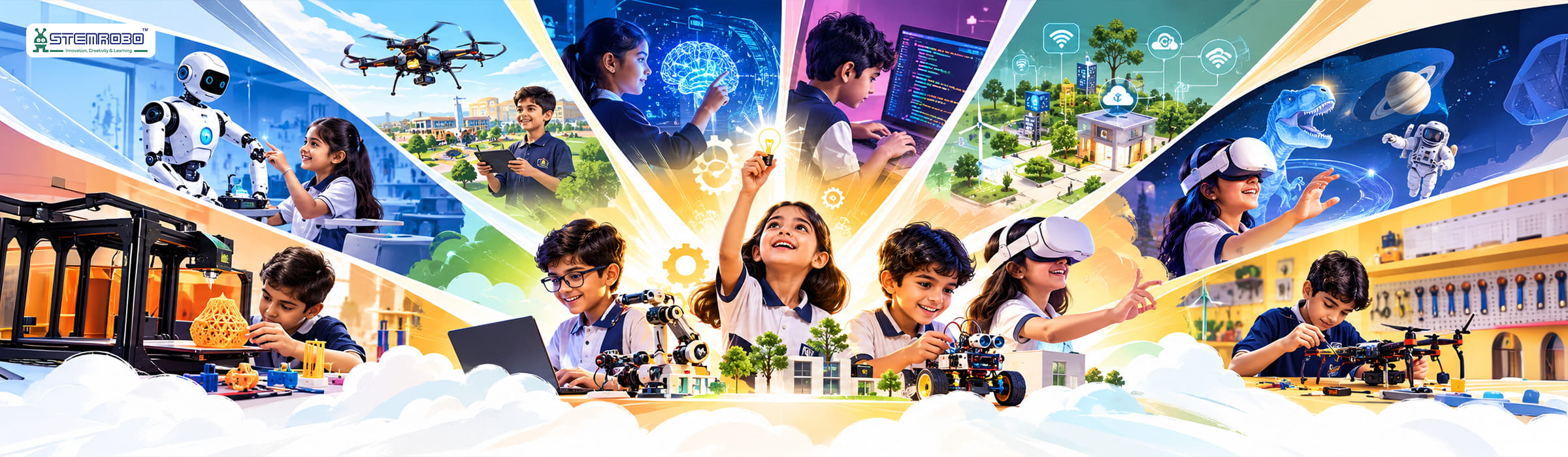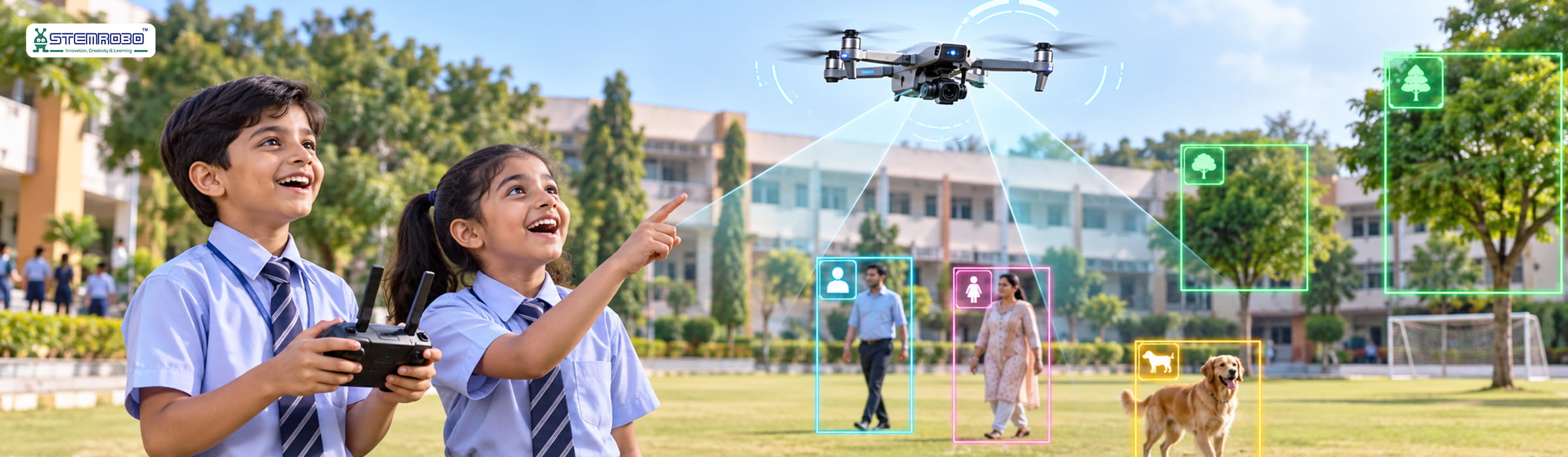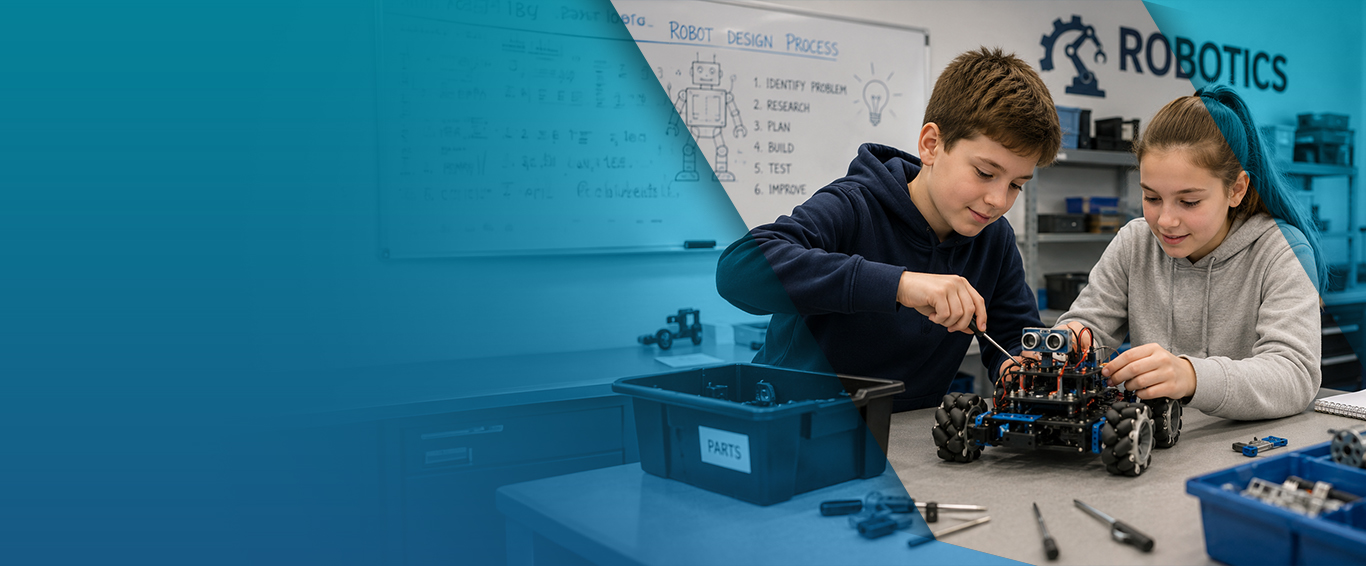
An AI Curriculum for CBSE Schools is a meticulously planned course designed to teach students Artificial Intelligence through programming languages, machine learning, robotics, and projects. As per the NEP 2020 and NCF 2023, this course helps children understand the art of critical thinking, problem-solving, and creativity at an early age.
AI Curriculum for CBSE Schools is a learning course structure for each grade that teaches students about Artificial Intelligence using practical methods, programming languages, projects, and teacher-led exercises.
The education system of today is preparing children for jobs which might not even be there. With the emergence of AI revolutionizing every industry in the world, the CBSE schools are adopting the study of AI in their curriculum.
In such conditions, the development of the AI Curriculum for Schools becomes inevitable as the introduction of this technology makes it possible for schools to move beyond just giving children a basic idea about computers. In order to educate students, teachers need to provide them with the opportunity not only to use the technology of Artificial Intelligence but to understand how such intelligent systems function.
In light of the NEP 2020 concept of learning and the NCF 2023 program of competency-based education AI becomes an integral part of school curriculum. The development of a thoughtful AI curriculum helps students to explore the newest technologies while improving their analytical thinking, collaboration and innovation skills.
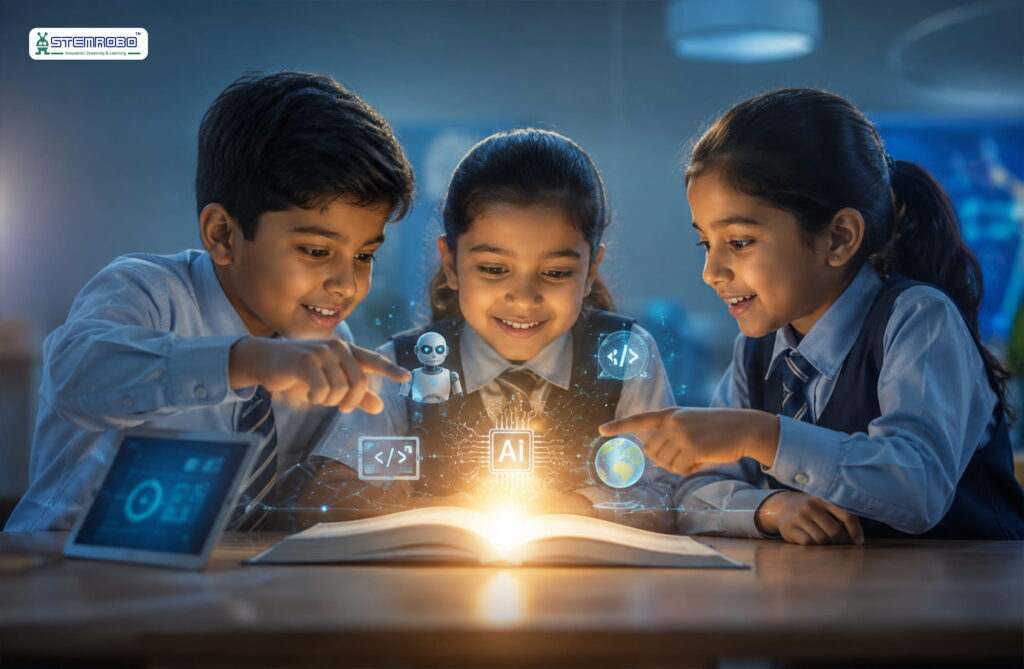
What is an AI Curriculum for CBSE Schools?
This is a plan that brings intelligence into learning in a way that fits the needs of students at every stage. As a student moves from one grade to the next the curriculum introduces subjects such as machine learning, computer vision, automation and data analysis. This helps students build thinking, imagination and problem‑solving skills while making the subject easy to understand.
The curriculum for intelligence education changes as students move from basic ideas to more advanced topics such as machine learning, computer vision, automation and analytics. It starts with concepts like how robots work or how machines make decisions. As students grow older they learn about real‑world applications, coding and tools that help them build systems. The goal is not to teach technology but to prepare students for a future where artificial intelligence is everywhere.
In general the following features make a complete artificial intelligence learning program:
- Grade Wise AI Curriculum
- Setting up of AI Lab
- Coding and Programming Sessions
- Machine Learning Projects
- Teacher Training
- Assessments, for Students
- Learning Management System (LMS)
- Academic Support Throughout
Why Are CBSE Schools Adopting AI Education?
The expectations from schooling have been completely different in the recent past. In the current world, other than delivering educational excellence, it is required of schools to prepare children for the tech era. With AI constantly making waves across industries such as medicine, financial industry, manufacturing, agriculture, and education, it is mandatory that AI learning be introduced in the school.
AI learning can be conveniently achieved with the help of the CBSE AI curriculum because here the learner acquires the ability to analyze the problems, innovate solutions, think critically and use AI to solve those problems. Hence, learners transition from being consumers of technology to innovators of technology.
Instead of taking AI as a separate subject, CBSE schools are combining AI with Future Skills Education.
Subjects Covered in an AI Curriculum for Schools
An all-inclusive AI Curriculum at CBSE Schools provides exposure to new-age technologies in a manner suited to children’s age groups, through learning, coding, projects, and experiments.
Following are some of the most important subjects included in an AI curriculum:
- AI Basics
- Coding & Programming
- Machine Learning Basics
- Computer Vision
- Natural Language Processing (NLP)
- Robotics & Automation
- IoT (Internet of Things)
- Data Science & Data Analysis
- Design Thinking & Innovation
- AI Ethics
Through these subjects, students are provided an insight into practical learning and gain the confidence to solve real-life problems.
Traditional Computer Education vs AI Curriculum
| Feature | Traditional Computer Education | AI Curriculum for CBSE Schools |
| Learning Approach | Theory-based | Project-based & experiential learning |
| Student Participation | Mostly classroom learning | Hands-on activities & innovation |
| Technology Exposure | Basic computer applications | Artificial Intelligence, Machine Learning, Robotics & IoT |
| Problem Solving | Limited | Real-world problem solving |
| Creativity | Moderate | High |
| Future Skills | Basic digital literacy | AI, coding, computational thinking & innovation |
| Career Readiness | Foundation level | Future-ready skill development |
Benefits of an AI Curriculum for Schools
AI Curriculum for CBSE Schools provides many benefits to the students, teachers and institutions too. Students get technology skills as well as skills in critical thinking, problem analysis and innovative solution development. Teachers get a tool to teach students interesting lessons, and institutions get a chance to become future-ready institutions with modern learning processes.
First of all, it makes students not only consumers but creators of technologies. They learn about how intelligent systems work to solve problems of the real world using the project-based learning approach.
Main Advantages:
- Development of critical thinking and logical thinking skills
- Improvement of computational thinking
- Encouragement of creativity and innovations
- Development of problem-solving skills
- STEM learning becomes more interesting for students
- Development of confidence in the projects
- Collaboration and communication improvement
Together, these benefits help schools build confident learners equipped with the knowledge and skills needed for higher education and future careers.
How Does an AI Curriculum Support NEP 2020 & CBSE?
The most significant benefit of implementing AI Curriculum for CBSE Schools is the compatibility of the program with the vision of NEP 2020, NCF 2023, and CBSE curriculum itself. The educational policies of these organizations promote the transition from the rote learning process to the competency and multidisciplinary one that equips children with skills to face future challenges.
Through AI education, children are encouraged to discover concepts with the help of various practical tasks, projects, and innovations. Rather than studying about the technology, students can implement the knowledge gained in the classroom to develop AI solutions and analyze different kinds of data.
Through this process, curiosity and critical thinking of children are stimulated as well as the creation of a future-oriented learning environment at school.
This also aligns with CBSE’s vision of promoting skill-based and experiential education in schools.
Future Opportunities for Students Learning AI
Learning Artificial Intelligence in school-level institutions creates various avenues which extend far into the future from the classroom environment. With AI revolutionizing various industries such as healthcare, finance, agriculture, manufacturing and even education, early learners have a solid platform that prepares them for further education and career paths.
An AI Curriculum in schools will also motivate students to engage in various innovation contests, hacking events, robotics contests, research studies and entrepreneurial ventures. This makes sure that they have the ability to solve problems in the current technology era.
Example bullets:
- Careers in AI
- Innovative Contests
- Higher Learning
- Projects Research
- Entrepreneurship
- Future Skills
Being introduced to AI early on gives students confidence and allows them to create strong portfolios.
How to Choose the Right AI Curriculum for CBSE Schools
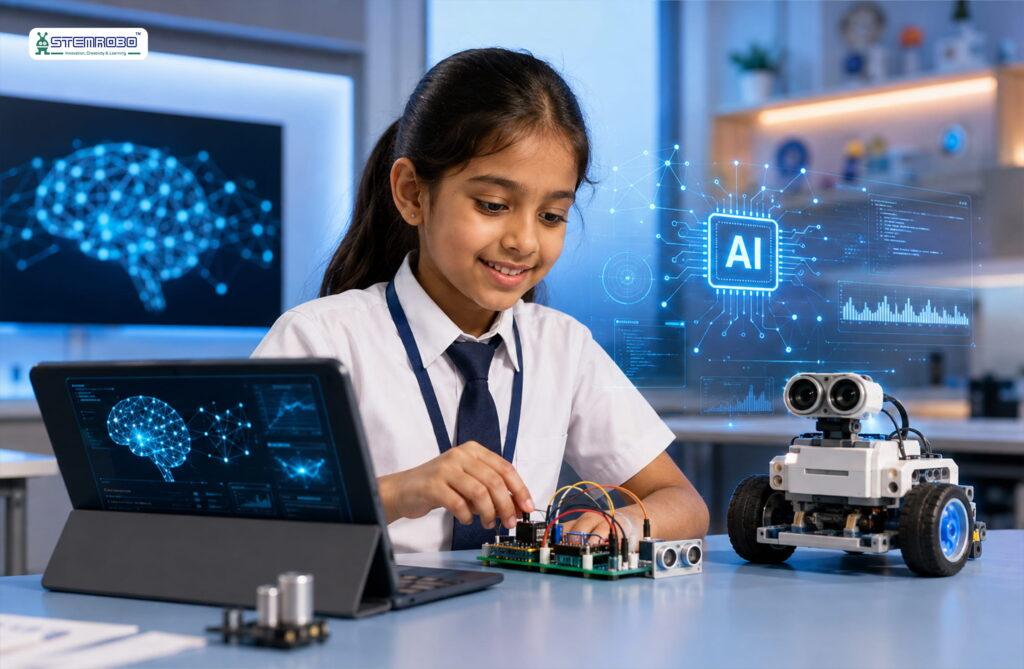
Selecting the right AI Curriculum for Schools goes far beyond just incorporating the latest technological inputs in the classroom. It is essential that schools create a learning environment wherein the students learn AI practically and the teachers can conduct engaging lectures.
The best partner in terms of AI learning is one which has a proper blend of all the components mentioned above.
There are some important components which must be kept in mind by schools while selecting their AI learning partner:
- Grade-wise AI Curriculum
- AI Lab Setup
- Teacher Training
- Practical AI Projects
- Coding & Machine Learning
- Student Assessment
- Learning Management System (LMS)
- Continuous Academic Support
- NEP 2020, NCF 2023 & CBSE Curriculum Aligned
Factors That Influence the Cost
The cost of deploying the AI Curriculum for CBSE Schools depends on many factors apart from just the development of the AI lab itself. The overall AI education framework includes various components, such as curriculums, infrastructure, Teachers’ training, software platform, assessment, and ongoing academic assistance.
Each school has different goals, student enrollment numbers, and requirements concerning the infrastructure. It is not right to compare the prices because the schools should consider the educational value and outcomes possible through the curriculum.
Factors That Affect the Cost of an AI Curriculum:
- AI Lab Setup
- Number of Students
- Grades
- AI Curriculum
- Coding and Machine Learning Components
- Teachers’ Training
- Learning Management System (LMS)
- Student Assessment
- Academic Assistance
Common Challenges Schools Should Avoid
Many AI education efforts do not yield any worthwhile results due to the fact that schools concentrate solely on technology rather than the entire learning process. In the absence of a curriculum, skilled educators, and academic mentorship, even state-of-the-art AI software can go unexploited.
Avoiding the above-mentioned pitfalls makes it possible for schools to establish an effective AI learning program that keeps students engaged all year long.
The following mistakes must be avoided by schools when it comes to their learning outcomes:
- Buying AI technologies without a curriculum in place
- Neglecting educator training
- Not providing hands-on learning chances
- Lack of an assessment framework for students
- No academic mentoring for students
Why STEMROBO is Among the Best AI Education Solutions for Schools in India
On selecting the Best AI Education Solutions for Schools in India, one needs to go beyond just the technology and choose a partner who can assist with full-scale implementation of the program. Here lies the unique value proposition that provides an end-to-end AI learning system including AI Lab Setup, CBSE Curriculum, Coding, Teacher Training, Assessments, LMS, Project-based Learning, and Academic Support.
- 5000+ Schools
- 2 Million+ Students
- 30+ Countries
- Grade-wise AI Curriculum
- Teacher Training
- AI Labs
- Learning Management System
- Continuous Academic Support
Conclusion
The role of Artificial Intelligence is becoming increasingly prominent among other educational technologies that will shape the future workforce. The schools which adopt the AI Curriculum for CBSE Schools now are not merely introducing yet another subject; rather, they are equipping the students with the necessary knowledge, creativity, and skills to thrive in the coming years.
A good AI education solution should consist of a number of components such as curriculum, learning, teacher development, assessment, and academic support for students.
The adoption of the right AI Curriculum for CBSE Schools is much more than introducing a technological innovation; it is a means of preparing classrooms and students for the future.
Frequently Asked Questions (FAQs)
1. What is an AI Curriculum for CBSE Schools?
An AI Curriculum For CBSE Schools is a planned learning programme in which students learn Artificial Intelligence through coding, projects, practicals and experience-based learning.
2. Which classes can learn Artificial Intelligence?
Artificial Intelligence can be taught right from the Primary classes through appropriate activities and can later proceed up to advanced concepts like Machine Learning, automation and data analysis.
3. How does AI education support NEP 2020?
Education in AI supports Experiential Learning, Critical Thinking, Interdisciplinary Approach, Innovation, Competency-based Education, etc., and hence is very well-suited to NEP 2020 & NCF 2023.
4. What subjects are included in an AI curriculum?
The following are some of the subjects that will be taught in an AI curriculum – Artificial Intelligence, Coding, Machine Learning, Robotics, Internet of Things, Data Science, Computer Vision, Design Thinking, and AI Ethics.
5. Why should schools choose STEMROBO for AI education?
STEMROBO provides a complete ecosystem for AI Education which includes AI Labs, Curriculums for Grades, Teacher Training, Assessments, LMS and Academic Support.
6. Can AI education be customized for different schools?
Yes. The AI learning programs can be customized as per the requirements of the grade level at which they are being conducted