
A student solves ten math problems. Gets seven correct. Close the tab. Move on.
On the surface, it looks like an ordinary learning moment.
But what about the three incorrect answers?
What if those mistakes hold the real story?
Every student leaves behind digital footprints while learning. Every quiz attempt, every paused video, and every repeated practice question creates a unique narrative. For many years, most of this information remained unused. It existed in storage, but it was never deeply analyzed.
That story has now changed.
Artificial intelligence has introduced a new layer of intelligence into academic systems. AI learning analytics transforms basic student information into meaningful insight. Schools can now use this insight to design personalized learning experiences that lead to measurable academic outcomes.
Education today does not need more complexity. It needs clarity. Learning technologies must enhance classroom capability while remaining transparent, intelligent, and adaptable.
Looking Beyond Test Scores
Traditionally, academic performance has been measured through marks and report cards. Grades show the final result, but they rarely reveal the journey behind that result.
Two students might score the same marks in mathematics. On paper, they look identical.
But imagine this:
One student truly understands the concept and can apply it in new situations.
The other has memorized steps without grasping the logic.
The score is the same.
The learning path is completely different.
AI learning analytics explores that journey. It studies:
- Time spent on each concept
- Patterns of incorrect attempts
- Frequency of revision
- Engagement levels during lessons
Instead of asking, “What score did the student get?” the system asks, “How did the student arrive at that score?” That shift changes everything.

Detecting Struggles Before They Grow
Academic decline rarely happens overnight. It begins quietly.
A missed concept.
A postponed assignment.
A slight drop in participation.
In a full classroom, identifying early warning signs is difficult. AI systems continuously monitor learning patterns and detect subtle changes.
For example:
A student begins taking longer to answer basic algebra questions.
Accuracy in related topics slowly declines.
Engagement with interactive modules drops.
Individually, these signs may seem minor. Together, they signal a learning gap forming.
Early alerts allow teachers to intervene before exam results damage confidence. Instead of reacting to failure, educators can prevent it.
Early detection becomes one of the most powerful academic tools.
Personalization That Feels Natural
Every student learns differently. Some students who learn through visual explanations need to learn through visual explanations because they can only grasp concepts through visual learning. Students demonstrate different learning speeds and learning styles and learning confidence because this variation is a natural occurrence.
AI learning analytics creates personalized learning experiences at scale because it detects student learning patterns. The system uses student performance and engagement data to recommend extra practice for weak areas and advanced challenges for fast learners and different content formats and real-world examples which improve understanding of concepts.
Teachers maintain their role as decision makers throughout the entire process. AI provides structured information which helps teachers make better responses to situations. The learning process becomes adaptive because standardized learning methods do not create effective learning paths for students.
Empowering Teachers With Clear Insights
AI learning analytics provides its most valuable advantage through its capability to transform complex information into easier-to-understand formats. Teachers can save time from manual spreadsheets and report review work because they can use visual dashboards which display their students’ mastery of different topics and classroom mistakes and student engagement patterns and academic progress throughout the week and month in an easy-to-understand format.
The educators can respond with accurate solutions because they receive complete information about student needs. Immediate revision occurs when most students face difficulties with a specific science concept. The class can continue at its regular pace when only one or two students require special assistance.
Teaching now shifts from reactive approaches to intentional methods. The instructional process achieves better results when decisions rely on actual data instead of making assumptions about teaching methods.
Measuring Growth, Not Just Achievement
Achievement is a snapshot. Growth is a journey.
AI learning analytics tracks development over time, revealing improvements that might otherwise go unnoticed.
Consider a student who consistently scores average marks. Over three months, analytics may reveal:
- Stronger concept clarity
- Faster problem-solving
- Improved accuracy
- Reduced dependency on hints
Even if the student is not at the top of the class, visible progress builds a lot of confidence.
When students see evidence of their own improvement, automatically motivation gets increased. Growth becomes visible. And visible growth fuels effort.
Strengthening STEM Learning With Data
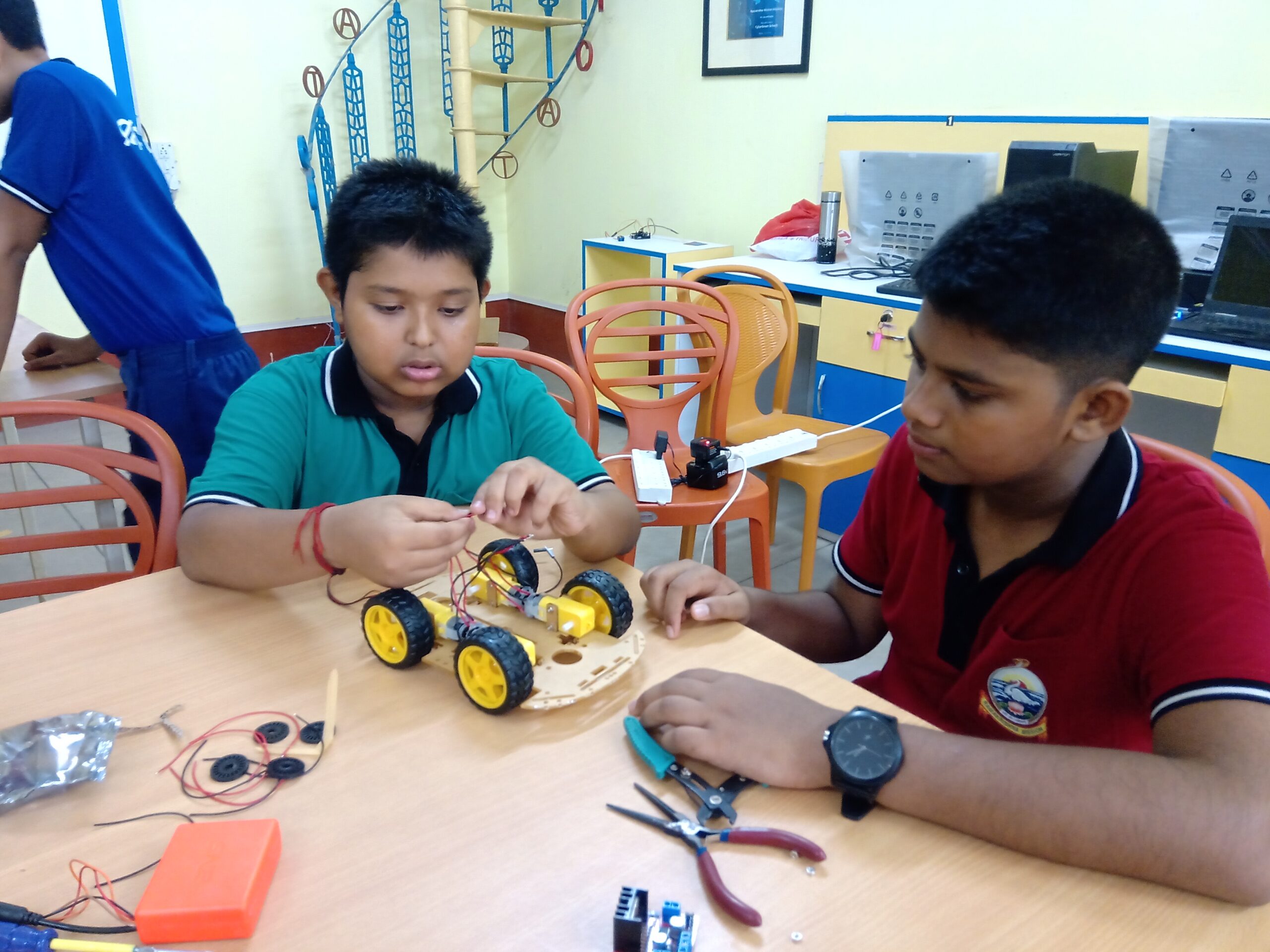
Learning programming, robotics, and applied science requires trial and error. Mistakes, debugging, and retries all generate valuable learning data.
AI learning analytics can track where logical reasoning breaks down, how many attempts lead to success, and which strategies are most effective.
For instance, a robotics student might complete projects successfully but take multiple debugging attempts. Analytics can reveal whether the challenge lies in logic sequencing or hardware understanding.
The focus shifts from the final output to the entire problem-solving process.
Through organizations like Stemrobo Technologies, we witness how AI-assisted analytics inculcates the merging of real STEM work with measured academic development.
Encouraging Student Ownership
One of the most empowering aspects of AI learning analytics is student visibility.
When learners access their own dashboards, they can see:
- Topics completed
- Areas requiring improvement
- Time invested in practice
- Performance trends
This visibility builds accountability.
Students begin asking themselves meaningful questions:
- Why am I struggling with this topic?
- Why has my accuracy dropped recently?
- How can I improve this pattern?
Over time, this reflection strengthens independence and confidence. Self-awareness becomes a powerful academic skill.
Supporting Smarter Institutional Decisions
The institution uses its AI analytics systems to support its strategic planning process.
School leaders need to examine grade-level and subject-based data patterns to discover existing educational deficiencies. The process enables organizations to assess their curriculum success while identifying specific teacher training requirements.
Schools need to offer teachers specialized training programs together with extra learning materials because they need to address specific student learning challenges which data indicates for certain subjects.
Ensuring Ethical and Responsible Use
The responsible use of data requires organizations to establish proper identity management systems that need secure storage and transparent policies together with their assessment methods. The purpose of information use should be explained to both parents and students.
Analytics must empower users instead of assigning them predefined categories. Data should drive development while it should never restrict what people can achieve.
Teachers use artificial intelligence to obtain knowledge while they teach students with human understanding and situational awareness and moral decision-making skills. The educational system benefits from technological tools which assist learning processes without removing the need for human comprehension.
The Future: Data With Purpose
Education is entering a phase where clarity matters more than complexity.
AI learning analytics transforms scattered classroom data into structured insight. It connects everyday learning behavior with long-term academic growth.
When used effectively, it can:
- Strengthen concept mastery
- Reduce learning gaps
- Improve teacher efficiency
- Increase student confidence
- Produce measurable academic outcomes
The true power of AI in education is not automation. It is awareness.
It helps schools understand what works, what needs improvement, and how students truly learn.
Conclusion
The field of AI learning analytics develops methods which educational institutions use to assess student achievement. The system assesses student progress through complete learning assessment which includes more than just report cards.
Teachers obtain better understanding.
Students receive better guidance.
Educational institutions acquire proof.
Educational institutions must use data-driven insights because this practice has become essential. The combination of human expertise with AI analytics creates a guiding system which enhances educational practice without taking control of it.
Educational systems need to develop systems which can assess every student’s situation to succeed in the future. Responsible data usage will transform educational data into the most effective academic achievement resource.