Education has always depended on assessment as its essential component. Teachers use quizzes, tests and examinations to assess student comprehension of concepts while determining which areas require further assistance. Traditional assessment methods require all students to take identical tests despite their different capabilities and interests and learning rates.
The approach of applying the same solution to every problem fails to show students actual learning capacity. Some students excel in timed exams while others struggle though they possess strong understanding of concepts. Schools now explore advanced assessment methods which combine educational technology with the diverse needs of their students.
Educational institutions implement artificial intelligence technology to enhance their assessment processes against existing challenges. Adaptive assessments and AI question paper generators and AI-powered assessment platforms enable teachers to assess students more efficiently while obtaining better insights about their educational development.
Rethinking the Purpose of School Assessments
In essence, traditional tests demand that students remember content and fill out forms under strict time limits. Students read over significant amounts of syllabus information and then sit timed tests that do not accurately measure knowledge depth in many situations.
A student’s success and advancement as demonstrated by a report card does not measure the breadth and width of all their actual academic achievements. A student might be poor at timed tests, but still learn content to an in-depth level. For some people, memory of content comes with learning, and application with failure in practice scenarios.
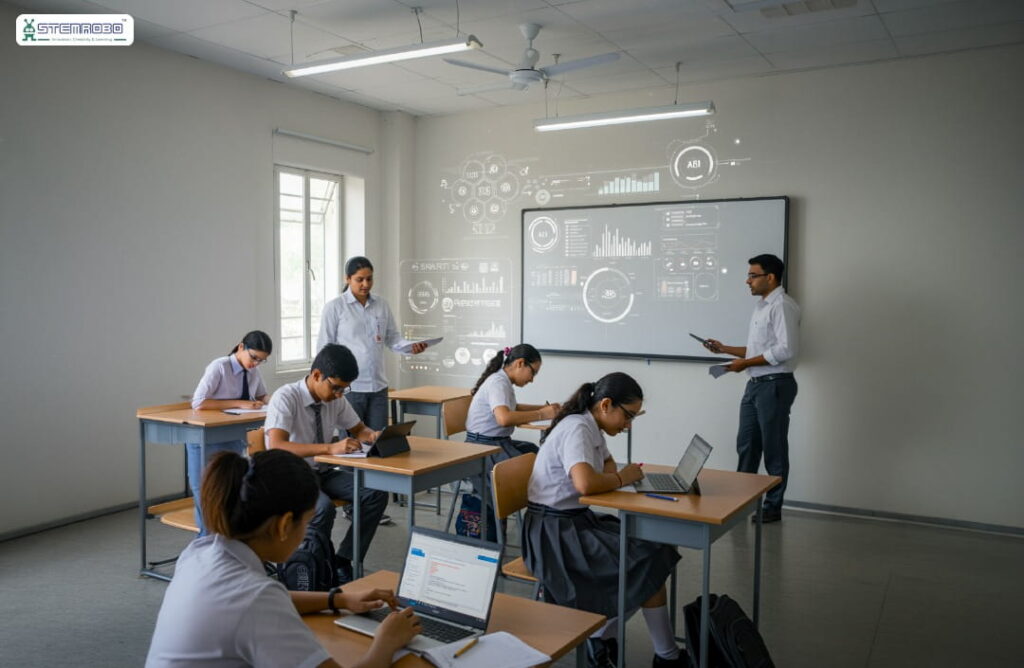
AI learning analytics permits the assessment of student achievement through the entire learning process, not just through test scores. This type of analytical system monitors how students approach questions, time spent per area, and content they are struggling with. The monitoring of learning patterns makes it possible for teachers to identify areas of deficit knowledge before they become too great.
Adaptive Assessments: A Smarter Way to Test
The assessment system uses adaptive testing methods which change question difficulty in response to student answers during the assessment. The system provides different test materials to each student based on their individual test results.
Benefits of Adaptive Assessments
- Questions become harder or easier depending on student responses
- Teachers gain a clear understanding of student strengths and weaknesses
- Assessments measure conceptual understanding instead of memorization
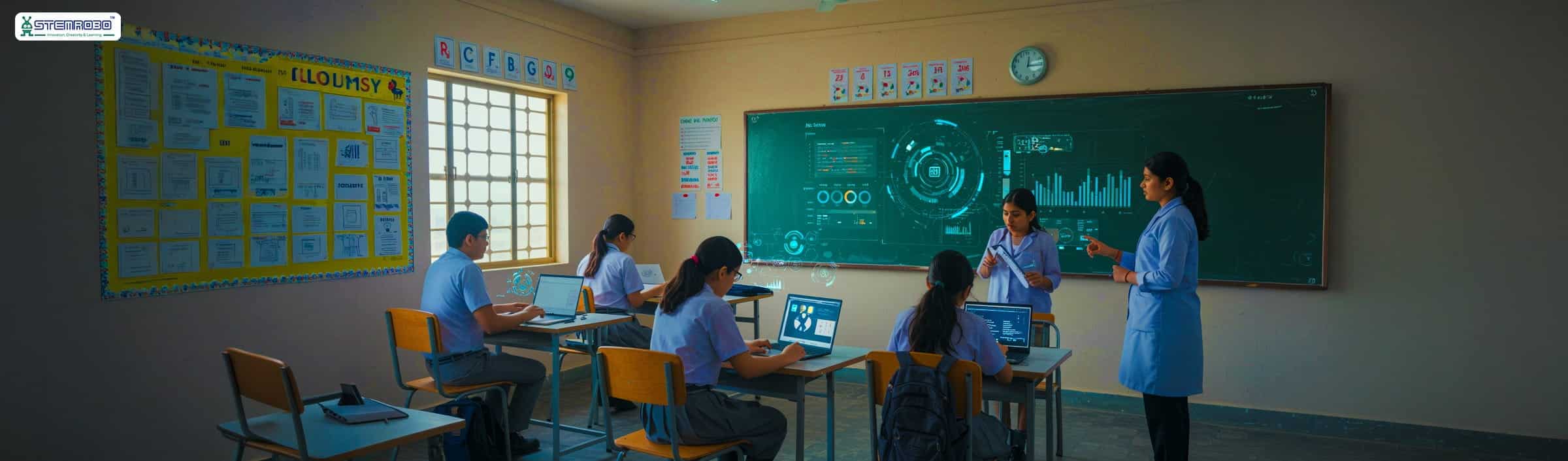
- AI dashboards display student performance, progress, and topic mastery
The assessment system delivers customized evaluations because it modifies test content based on students’ performance throughout the assessment process. Teachers receive essential information which enables them to assist their students in more efficient ways.
AI Question Paper Generators: Saving Time for Teachers
The process of creating balanced and meaningful examination papers requires teachers to spend extended periods of time. The AI question paper generators create assessments through their use of generative AI technology which enables them to complete their work in an efficient and rapid manner.
Teachers provide the system with essential information about the subject matter, required class level, selected topics and desired difficulty level of the examination. The system then produces an entire question paper which meets the specified learning objectives.
Key Advantages
- Complete test papers can be generated within minutes
- Teachers can edit and customize questions easily
- Multiple versions of the same exam can be created
- Helps reduce cheating in large classrooms
Teachers can generate multiple assessment sets within a short period of time which allows them to concentrate on classroom learning improvements.
AI Classroom Tools Supporting Assessment
Current educational assessment systems employ artificial intelligence technology which functions as automated systems within digital academic platforms designed for educational instruction and student educational progress tracking.
The educational institutions investigate advanced assessment platforms which Stemrobo Technologies has created to demonstrate how their AI classroom tools, research-based student assessment methods and educational data tracking systems work together to monitor academic development and enable active student engagement.
The majority of educational institutions implement AI tutoring software which enables students to study academic material after school ends. Students can review lessons, ask questions, and strengthen their understanding through guided practice.
The Power of Learning Analytics
The educational field gains its most significant advantage from artificial intelligence because it can process extensive educational data to generate insights.
The AI learning analytics system tracks student activities by measuring their quiz results, lesson participation, time allocation, and general classroom involvement. The system provides teachers with insights about student learning patterns while identifying student learning obstacles.
The system uses predictive learning analytics to detect potential learning challenges before they develop into major educational issues. The system automatically identifies patterns when multiple students experience ongoing difficulties with specific subjects, such as geometry or fractions, which leads to teacher notifications about the situation.
Teachers can use this time to review essential topics while they help students gain additional practice which will lead to better academic results before final examinations. Assessments transform into instruments that promote educational progress because they extend beyond their function of measuring student achievement.
Personalized Learning Through AI
AI-driven assessments also make personalized learning possible.
How AI Enables Personalized Learning
- Creates custom learning paths based on student performance
- Provides additional practice for weaker concepts
- Allows advanced learners to progress to more challenging material
- Continuously adjusts learning activities based on performance data
Because every student learns differently, personalized assessments help ensure that learning experiences match each student’s pace and ability.
The Future of AI-Powered Assessments
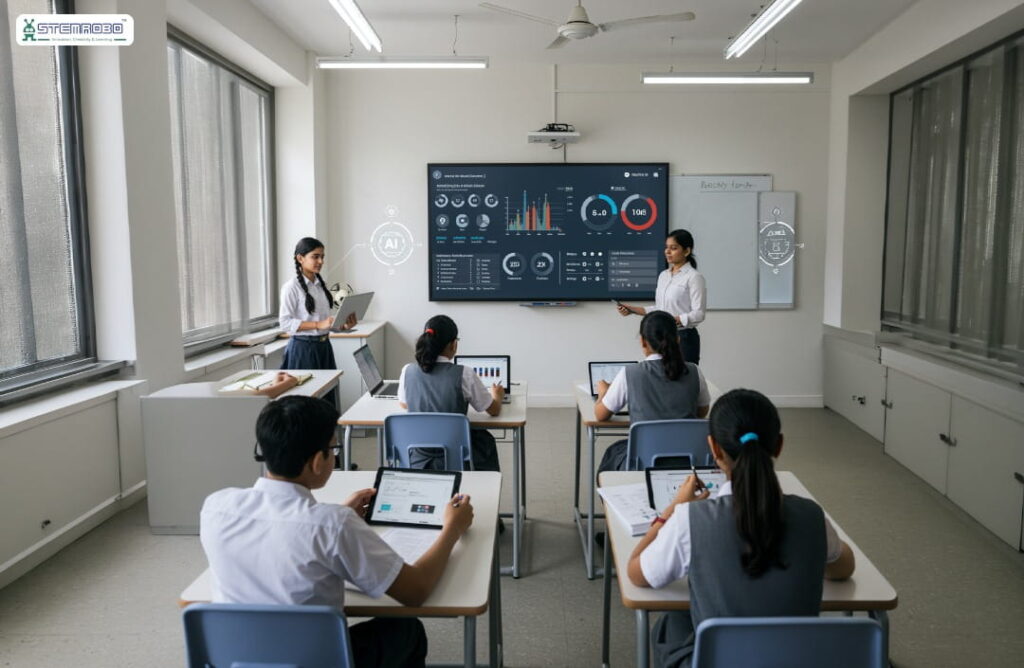
As artificial intelligence develops further school assessments will achieve greater interactivity and assessment value.
Future evaluation systems may include simulation-based assessments, project-based tasks and real-world problem-solving activities. These methods will enable schools to assess practical skills and creative abilities and critical thinking skills which go beyond standard memorization methods.
Teachers will gain access to advanced learning analytics systems which present in-depth knowledge of student progress in conceptual understanding and reasoning skills and skill development throughout their academic journey.
Some innovative schools are already experimenting with continuous assessment models where student progress is monitored throughout the learning process rather than only during final exams. The new method changes assessment tests into tools which enable students to learn continuously.
Conclusion
The assessments exist to measure students’ learning progress, but traditional testing methods fail to show students’ complete abilities. The combination of fixed question papers and time-limited exams together with delayed feedback systems creates challenges for teachers who need to monitor student progress.
Artificial intelligence provides educational institutions with its strongest solution. Schools can establish their evaluation systems through flexible data-driven evaluation systems which include AI question paper generators and adaptive assessments and AI assessment software and AI learning analytics tools.
Assessments become essential components of the educational process when educational chatbots and AI tutoring software and classroom analytics tools work together. Schools develop intelligent evaluation systems which enable students to develop their skills while building their curiosity and achieving academic success.