21st Century Skills

21st-Century Skills

21st Century Skills for Teachers: Why Educators Must Evolve Too

21st Century Skills for Teachers: The Real Starting Point of Classroom Transformation When educators discuss 21st century skills, they almost always centre the conversation on students — their creativity, their digital fluency, their collaborative instincts. But the most important variable in any classroom transformation is the teacher. An educator who still delivers rote-recall lessons cannot build critical thinkers. That makes developing 21st century skills for teachers non-negotiable — it is the prerequisite for everything else. What Modern Educators Need to Do Differently Modern educators must operate with a fundamentally different skill set from what schools expected a generation ago. They must move from being the sole authority in the room to becoming a facilitator of inquiry — someone who guides students toward discovery rather than simply delivering answers. Teachers must also feel confident integrating technology into their daily practice. Not as a substitute for teaching, but as an amplifier of it. Beyond that, they need to design learning experiences that build the six competencies that research consistently identifies as most critical for students entering a technology-driven economy: Teachers cannot deliver these skills secondhand. They must embody them first. A teacher who works through a hands-on robotics project — debugging code, iterating on a design, presenting findings to peers — understands experiential learning from the inside. That lived understanding separates a lesson that checks a curricular box from one that genuinely shifts how a student thinks. Why Ongoing Professional Development Changes Everything A one-day training workshop changes nothing. For 21st century teaching practices to take hold, educators need regular exposure to new pedagogical tools, subject-specific upskilling in areas like AI and data science, and a sustained community of practice with fellow educators navigating the same transition. Schools that invest in teacher development as seriously as they invest in student programmes build something rare — a culture where 21st century skills grow at every level simultaneously, because teachers model what learning looks like. STEMROBO’s Teacher Training Programme equips educators with hands-on STEM and AI pedagogy, structured certification, and ongoing support. [Explore Teacher Programme →] How 21st Century STEM Education Differs from Traditional Learning Education no longer stays confined to classrooms and textbooks. The shift toward 21st century STEM education pushes students to experiment, apply knowledge, and solve real-world problems — building far deeper understanding than passive reading ever produces. Three differences stand out most clearly: The Structural Gap Between Traditional and STEM Education The difference between conventional schooling and modern STEM-integrated education goes beyond teaching style. Every dimension of how schools organise, assess, and deliver learning looks different. Dimension Traditional Education 21st Century STEM Education Teaching approach Teacher leads; students receive Teacher facilitates; students discover Curriculum structure Subjects taught in isolation Cross-disciplinary, integrated projects Student role Passive listener Active maker and problem-solver Assessment Standardised written exams Project portfolios and practical demos Technology use Occasional and supplementary Central — coding, robotics, AI are core Failure & iteration Penalised; wrong answers lower grades Expected and valued in the design process Collaboration Individual work dominates Team-based projects mirror workplaces Teacher’s role Sole knowledge authority Facilitator, coach, and co-learner What Hands-On STEM Learning Actually Looks Like in the Classroom The phrase hands-on STEM learning gets used broadly, but its meaning is specific. Students learn by doing, making, testing, and iterating — not by reading about what others have done. The outcomes speak for themselves. A 2023 meta-analysis of K–12 STEM programmes found that project-based, hands-on approaches improve conceptual retention by up to 40% compared to traditional instruction. Here are four activities that deliver hands-on STEM learning at its most effective: 1. Bridge-Building Under Constraint Students design and build a bridge using only spaghetti and marshmallows, with the goal of supporting maximum weight. In a single session, they practise structural engineering, load distribution, iterative testing, and team decision-making — often without realising how much they’re absorbing. 2. Programmable Robotics Challenge Using a STEMROBO kit, students programme a robot to navigate a maze, pick up objects, or sort items by colour. They apply logic, write coding sequences, and interpret sensor data — connecting computer science theory to physical outcomes they can see and adjust in real time. 3. Water Quality Testing Project Students collect water samples from different sources, test pH and turbidity using lab equipment, record their findings, and present results to the class. This single project covers chemistry, data collection, environmental science, and scientific communication — exactly the multi-domain thinking that modern STEM education develops. 4. AI Image Recognition Mini-Project Students train a simple machine learning model using a visual dataset — teaching a classifier to identify leaf types or geometric shapes. They label data, run the model, assess accuracy, and refine their training set. This hands-on process builds AI literacy through direct experimentation, not abstract explanation. All four activities come as structured, curriculum-mapped modules inside STEMROBO’s STEM Lab programme. [Explore STEM Lab →] How STEM Education Closes the Learning Gaps Traditional Methods Create Traditional education often teaches subjects in isolation. Students memorise facts but struggle to see how those facts connect to real problems. When doubts go unanswered, learning gaps form. As difficulty grows, those gaps become fear of the subject. STEM education tackles this directly. Students learn concepts by applying them, not by reading about them. They build understanding through doing. And because the process treats failure as a normal part of design thinking — not something to penalise — students take intellectual risks more willingly. Think of it this way: when someone hears a story, they might forget it. When they watch the same story unfold in a film, it stays with them. STEM education applies that same principle to learning — when knowledge becomes an experience, it sticks. How STEMROBO Delivers This Across K–12 Schools STEMROBO provides an all-inclusive STEM education solution for K–12 schools, built around a grade-wise progressive curriculum that adapts to each level. The programme integrates STEM concepts with academic subjects, creating interdisciplinary learning that keeps students engaged from the earliest grades onward. The approach does not ask

21st Century Skills for Teachers: Why Educators Must Evolve Too Read More »
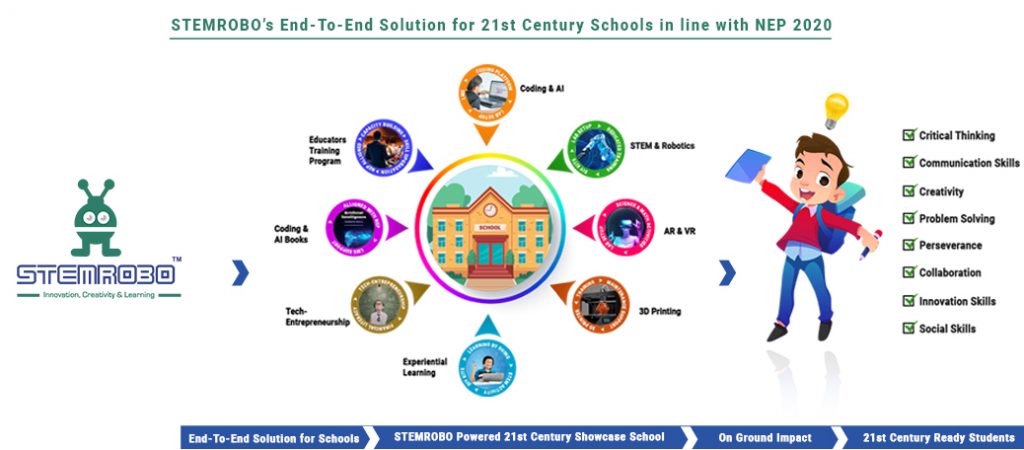
K–12 schools and students’ end-to-end solutions

How Does STEMROBO Cater to Learning and Innovation Skills for Students?

Interactive and Collaborative Learning The main goal of STEMROBO is to create a learning atmosphere that is exciting and engaging along with preparing the students for great opportunities and challenges for the upcoming future. STEMROBO is at the forefront of transforming the educational system. It focuses on Hands-on learning experiences, providing End-To-End Solutions for K-12 Schools, exposure to modern technology, and basic skill development which guarantees that students will not only study but also grow into creative problem solvers ready to make an impact on the world of today and tomorrow. The platform offers K–12 schools and students’ end-to-end solutions. This commitment is a result of the goal to foster creativity and 21st-century abilities by giving children, ages 6 to 18, the opportunity to learn through STEAM, AI, robotics and coding curriculums. At STEMROBO, we are not simply shaping the personalities of Students; We are cultivating a learning and innovation environment that is redefining education. Our methodology isn’t about course books and talks; it’s an exciting journey into the world of possible outcomes where students become innovators, creators and problem solvers. The STEAM (science, technology, engineering, art, and math) subjects are actively and interactively promoted to students. Through cooperative tools implanted inside the STEMROBO’s Learning platform, students can take part in conversations, group projects, and interactive activities. This methodology improves their understanding as well as develops collaboration, teamwork, and communication skills. Engaging Curriculum: Our educational plan is a mix of Science, Innovation, technology, and Math combined with Robotics, Coding, and Artificial Intelligence (AI). It’s not only about studying it’s about applying the knowledge in real-life applications through hands-on projects. By mixing innovative teaching methodologies with this technology, students gain more understanding of Science, Technology, Engineering, Arts, and Mathematics Project-Based Learning: We believe in learning by doing. That is the reason our methodology focuses on project-based learning. for this, we provide tools and kits for students Progressive Skill Development: Starting from the basics and gradually moving to advanced concepts, our curriculum is designed to develop students’ logical thinking, computational skills, and creativity. It’s a bit-by-bit journey that transforms students into innovators and creators. Real-Life Exposure: We offer students a taste of the future through technology at an early age. Being ready for the latest advances such as IoT, coding, artificial intelligence, and mechanical technology allows them to gain knowledge in these fields and prepares them for future challenges. For this, we have a portion of our courses, studios, and meetings: Workshops and Sessions: Our series of workshops and tinkering sessions cover advanced technologies, like as AI, IoT, 3-D design, Arduino & Sensors, Raspberry Pi, Drones, and more. These hands-on activities help students dive into the cool world of new ideas and technology. From Consumers to Creators: Our methodology enables students to evolve from passive consumers to proactive creators. They begin with kits and platforms, gradually gaining skills to innovate and create products that can have a real impact on the world. STEMROBO’s unique methodology guides students through a transformative journey. Starting as consumers, students develop into innovators and creators. From fundamental concepts to market-ready product creation, our education program encourages critical thinking, imagination, creativity and problem-solving skills. Real-life exposure to coding, AI concepts and advanced technologies further fuels their innovation journey. students are provided with End-to-end solutions regardless of their location or curriculum. Our platform enables students aged 6-18 to explore, experience, and innovate through STEAM Education, AI, Robotics, and Coding curriculums Additionally, it provides learning Management System (LMS) support for both students and teachers. With its simple explanations and anytime, anywhere access to learning materials, Students may connect with STEAM subjects more engagingly and collaboratively by using the LMS. Beyond student empowerment, STEMROBO also focuses on teachers’ support to enhance classroom dynamics. By integrating learning and innovation into regular sessions, teachers can make classes more engaging and informative. Technical sessions and backend support for competitions further enhance the learning experience. How Does STEMROBO Cater to Learning and Innovation Skills for Teachers? STEMROBO’s primary goal is to enhance teaching methods by upgrading individual development through professional expertise in the fields of STEM, Robotics, Coding, and AI. For this, we have got lots of experience and a special way of teaching that’s really good. we provide high-quality training to help you set up teaching standards that exceed expectations. Empowering Educators for Transformative Teaching STEMROBO is not only an educational platform; it’s a movement that transcends traditional teaching boundaries. STEMROBO is a platform that provides teachers and students with the skills, resources, and perspectives that are required to succeed in a world that is changing quickly. we understands that the driving force behind exceptional education lies in empowered educators. The platform offers specialized training programs designed explicitly for teachers. These programs serve as a gateway for educators to upskill, ensuring they remain at the forefront of 21st-century teaching and learning methodologies. Through the Professional Development Courses and the Educator Certification Program, teachers gain invaluable insights and skills crucial for creating engaging and impactful learning experiences. At STEMROBO, you’ve got access to First-class educational materials organized by our expert team. This includes a comprehensive curriculum customized to different grade levels, detailed session planners, and lesson plans specifically designed for teachers – everything you need is right at your fingertips. Learning coding is very easy with the STEMROBO Platform. · Our integrated coding platform and code files are there for teachers, making hands-on coding education seamless. · We’ve streamlined the whole process so you can focus on teaching coding without any hassle For this, we have Courses like: Professional Development Courses: STEMROBO provides specialized training for teachers to enhance teaching quality. Educator Certification Program: Equipping teachers with 21st-century skills. Support for Establishing Activity Centers: Encouraging innovation within local communities. Tinker and STEAM Certification Courses: These specialized courses empower educators with 21st-century skills, integrating Robotics, Sensors, Electronics, and Coding with STEM concepts. Teachers learn how to inspire innovative solutions, fostering an environment where students can explore and create Enhanced Learning through STEMROBO’s LMS Platform We

How Does STEMROBO Cater to Learning and Innovation Skills for Students? Read More »

21st-Century Skills

The Impact of STEMROBO’s Curriculum on Students’ 21st-Century Skills

In the ever-evolving landscape of education, the significance of curricula in shaping students’ future-ready skills cannot be overstated. Today, educational programs are tasked with not only imparting knowledge but also cultivating the critical skills necessary for success in the 21st century. The Evolution of Education: Beyond Knowledge Transfer Traditional educational models primarily focused on transferring knowledge, often neglecting the holistic development of students. However, the contemporary educational paradigm recognizes that students need more than just information; they need a set of skills that will empower them to thrive in an ever-changing world. 21st-century skills encompass a diverse set of abilities that extend beyond traditional academic knowledge. These skills include critical thinking, creativity, collaboration, communication, adaptability, and problem-solving. A STEM curriculum that successfully nurtures these skills goes beyond rote memorization, encouraging students to actively engage with the learning process. Project-Based Learning: Fostering Collaboration and Creativity Innovative curricula leverage project-based learning as a powerful tool to cultivate collaboration and creativity. Students are not passive recipients of information but active participants in projects that require them to collaborate with peers, think critically, and creatively solve problems. This approach mirrors the real-world scenarios students will encounter in their future careers. Hands-On Exploration: Igniting Curiosity and Critical Thinking By incorporating hands-on exploration into the curriculum, students are encouraged to question, experiment, and discover. This approach fosters curiosity and critical thinking, laying the foundation for a mindset that thrives on inquiry and problem-solving. Students become adept at analyzing information, making informed decisions, and adapting to different situations. Cross-Disciplinary Connections: Bridging Gaps in Understanding Innovative curricula recognize the interconnectedness of knowledge across disciplines. Rather than compartmentalizing subjects, these curricula encourage cross-disciplinary connections. Students understand that real-world challenges often require a multifaceted approach, and by integrating knowledge from various domains, they are better equipped to address complex issues. Technology Integration: Preparing for the Digital Age The 21st century is defined by rapid technological advancements. Innovative curricula seamlessly integrate technology into the learning process. Students not only learn to use technology as a tool but also understand its ethical implications, ensuring they navigate the digital age responsibly. Technological literacy becomes a natural outcome of the learning experience. Cultivating Soft Skills: Effective Communication and Collaboration Beyond technical skills, successful professionals in the 21st century Skills in schools need strong soft skills. Innovative curricula prioritize the development of effective communication and collaboration skills. Students engage in activities that require clear articulation of ideas, active listening, and constructive feedback, preparing them for the demands of teamwork in the professional world. Emphasis on Lifelong Learning: Adapting to Change In a world where change is constant, the ability to learn continuously becomes a valuable skill. Innovative curricula instill a love for learning that goes beyond the classroom. Students develop the resilience and adaptability to embrace change, viewing challenges as opportunities for growth rather than obstacles. Traditional assessment methods often fall short in capturing the holistic development of students. Innovative curricula employ diverse assessment tools, including project evaluations, presentations, and portfolios, providing a more comprehensive understanding of students’ abilities. This approach ensures that assessments align with real-world expectations. Teacher as Facilitator: Nurturing Independence and Initiative Innovative curricula redefine the role of the teacher from an information provider to a facilitator of learning. Teachers guide students through the learning process, encouraging independence and initiative. This shift empowers students to take ownership of their education, fostering a sense of responsibility and self-directed learning. Successful curricula extend beyond the confines of the classroom, engaging students with the real world. Innovative curricula facilitate community partnerships, internships, and real-world projects. This connection to the community not only enhances the relevance of learning but also instills a sense of civic responsibility in students. Preparing Global Citizens: A Global Perspective Innovative curricula acknowledge the global interconnectedness of the 21st century Skills for Students are exposed to diverse perspectives, cultures, and global issues. This global awareness prepares them to be responsible and empathetic global citizens who can navigate the complexities of an interconnected world. Shaping Leaders of Tomorrow In conclusion, the impact of innovative curriculum on students’ 21st-century skills transcends the boundaries of traditional education. By prioritizing collaboration, creativity, critical thinking, and adaptability, these curricula mold students into well-rounded individuals equipped to navigate the challenges of the modern world. As education evolves to meet the demands of the 21st century, innovative curricula stand as beacons of transformation, shaping leaders who are not just knowledgeable but also resilient, creative, and prepared to make a positive impact on the world.

The Impact of STEMROBO’s Curriculum on Students’ 21st-Century Skills Read More »

Why is STEM Education Crucial for Nurturing 21st Century Skills in Students

Why is STEM Education Crucial for Nurturing 21st Century Skills for Students?

In the dynamic landscape of the 21st century, education is not merely about acquiring knowledge; it’s about equipping students with the skills needed to thrive in an ever-evolving world. At the forefront of this educational revolution stands STEMROBO Technologies, recognizing the indispensable role of STEM education in nurturing 21st-century skills among students aged 6-18. STEMROBO’s Holistic Approach to 21st Century Skills STEMROBO’s commitment to nurturing 21st-century skills is deeply embedded in its holistic approach to STEM education. The curriculum, encompassing subjects like Robotics, AI, and IoT, is carefully crafted to instill not only knowledge but also critical skills such as problem-solving, creativity, collaboration, and adaptability. As we navigate the complexities of the 21st century, traditional educational paradigms are proving inadequate in preparing students for the challenges that lie ahead. STEM education, an acronym for Science, Technology, Engineering, and Mathematics, transcends these traditional boundaries, offering a multidisciplinary approach that mirrors the interconnected nature of our modern world. Fostering Critical Thinking Through Hands-On Learning At the heart of STEM education lies the principle of hands-on learning, a principle that STEMROBO passionately embraces. This approach is a powerful catalyst for fostering critical thinking skills among students. By engaging in real-world projects and experiments, students are not just memorizing information; they are actively applying their knowledge to solve practical problems. Creativity is the driving force behind innovation, and STEM education serves as a fertile ground for cultivating this essential skill. STEMROBO’s curriculum encourages students to think outside the box, explore unconventional solutions, and embrace failure as a stepping stone towards success. Through robotics, coding, and AI programs, students are empowered to become creative thinkers who can tackle challenges with ingenuity. Navigating Technological Advancements with Adaptability In an era defined by rapid technological advancements, adaptability is a skill that can’t be overstated. STEM education, as facilitated by STEMROBO, equips students with the ability to navigate the ever-changing technological landscape. By exposing them to cutting-edge technologies and innovative learning methods, students develop a natural agility that positions them as adaptable problem solvers. Collaborative Learning for Effective Communication 21st-century skills extend beyond individual proficiency to include effective communication and collaboration. STEMROBO’s approach to STEM education emphasizes collaborative learning experiences, mirroring the teamwork and communication required in professional settings. Students learn to articulate their ideas, work seamlessly in teams, and share their findings effectively. The ability to solve complex problems is a cornerstone of success in the 21st century. STEM education, championed by STEMROBO, provides students with the tools to analyze problems critically, break them down into manageable components, and develop innovative solutions. These problem-solving skills are transferable, preparing students for challenges in various aspects of life. In a world where knowledge evolves at an unprecedented pace, the importance of instilling a passion for lifelong learning cannot be overstated. STEMROBO’s STEM education programs go beyond traditional teaching methods, inspiring students to embrace curiosity and a hunger for continuous learning. This passion becomes a driving force for ongoing personal and professional development. STEM education emerges as the linchpin in the process of nurturing 21st-century skills among students. STEMROBO Technologies, with its innovative curriculum and hands-on learning approach, stands at the forefront of this educational revolution. By fostering critical thinking, creativity, adaptability, effective communication, and problem-solving, STEM education becomes the cornerstone in shaping leaders who are not just academically proficient but poised to excel in the challenges of the 21st century. As we witness the transformative impact of STEM education, it becomes clear that investing in these programs is an investment not only in the academic success of students but in the future leaders who will drive innovation, solve global challenges, and shape the world for generations to come.

Why is STEM Education Crucial for Nurturing 21st Century Skills for Students? Read More »
