
Click For Schools

Learning and Innovation skills

STEM education for kids

Behind Every Great Meal Is Science: STEM Careers Rising in the Food Industry

The food that we have everyday, the supplements that we take, the crops that are grown to get the yield we want everything involves science and technology and so it makes the whole scenario something to improve and work upon. Because it is of outmost importance that we have the food that is both healthy and safe for our body. Therefore, we can understand that STEM education for kids is not just a subject, it is a way of making our living sustainable, healthy and economical. How STEM Education Is Transforming the Modern Food Industry A few years ago, the way of us taking food was simple: grow the crops, harvest it and then consume it. But as the complexities in health and environment are increasing, we need to make sure that we take all the measures. But the modern world requires more precision, more safety, and more innovation. This is where STEM steps in. Now, most of the food we eat has been produced with modern STEM farming and irrigation, tracked with complex IoT and GPS till it reaches our doorsteps and the list goes on. Not much time before the factories and all the physical work was done by people only but now that the technology is better, the factories now use complex machines Factories that once relied solely on manual labour now operate like high-tech laboratories. Robotic arms pack snacks at speeds that humans cannot match. Vision-based systems identify imperfections in fruits with exceptional accuracy.   The Role of Science in Creating Healthier and Safer Food Today, the food we eat are all part and parcel of STEM. From the pesticides and the irrigation to the farming processes used during the whole setup from the seeding to the yielding is all a part of science. Scientists and researchers are finding out ways to keep food fresh for a longer time and how it can be grown in offseason and also finding useful alternatives to foods through cultivation of a new or same family vegetable or manufacturing supplements for it. Engineering and Sustainability: Building the Future of Food Production Food engineers mainly work on how food is made, stored, packed and kept safe.and scientists and chemical engineers look over making the food more nutritious, safe and easily accessible. Together, both groups play important roles. Food engineers handle the how, while scientists and chemical engineers handle the what. This teamwork helps ensure that the food we get is safe, healthy and available whenever we need it. Mathematics: The Hidden Logic Behind Every Food Decision For a sustainable and conserving society, it is very important that we don’t let food go to waste. We can make sure of this by studying the market trends and the demand supply. This way, the decision makers can only enough stock according to the demand. The rise of food analytics, predictive modelling, and algorithm-driven decision-making has created new opportunities for students who enjoy logic and numbers. STEM in Agriculture: Where the Story of Food Begins The food industry begins in the soil where the crops are grown and to get the best yield, the quality of the soil matters. The irrigation methods, the pruning, the tilting etc, are all components that require technology. Farmers now use, seed bomb, drones, sensors etc to monitor the health and quality of the crops.STEM is more jobs for the future generation in the field of food. That is why, Learning and Innovation skills for students are introduced to students at an early age. Food Safety and Quality: Protecting Health Through Advanced Science People now are always on the go and so we the food also needs to be fast and ready to go. Therefore, things like quick commerce, ready-to-eat, tiffin service, supplements etc are trending to suit with the lifestyle of the people. There are now special labs and testing units that look over the food safety. They look over everything from the ingredients to packaging and storage conditions. With the rise of packaged food and ready-to-eat meals, ensuring safety has become more complex. Laboratories now rely on advanced technologies like biosensors, rapid microbial testing, and AI-powered risk detection to ensure that food remains safe. Food safety specialists examine everything from ingredients to packaging to storage conditions. Jobs in food quality checks, testing labs and rule-checking departments are very important today. These people make sure that we eat are clean, safe and also meets the safety standards. People in these roles make sure the food we eat is safe, clean and meets all safety standards. Their work helps keep people healthy and makes customers trust the food they buy. Culinary Innovation: When Creativity Meets Technology Today even kitchens use STEM for a better experience. Like checking the specific temperature for the food, oven temperature, fermentation, grilling, roasting etc. This integration of culinary and technology is a new method to make food that is both enjoyable and healthy. And the jobs in this field are also much more dynamic. Why STEM Careers in the Food Industry Are Growing Rapidly The population is increasing and so is the need for good and nutritious food. So, there is a need for food scientists, chemical scientists and chemists etc and the list goes on. That is why STEM education for Students is important. The future is dynamic and so the students need to prepare for careers that don’t even exist in the present. How Early STEM Exposure Shapes Future Food Innovators Starting early is always encouraged and when students are introduced to the magic of STEM education at an early age, they develop the essential 21st century skills that are required to live a good life in a society. They learn to connect the textbook learning to practical learning. And now with the increase in competition and population, we need to make sure that the kids are well prepared to solve problems like starvation, drought, malnutrition etc. STEM Education Solution Providers Company like STEMROBO, with their experiential learning programs, robotics labs, and AI-driven

Behind Every Great Meal Is Science: STEM Careers Rising in the Food Industry Read More »
Stem Education Consulting Company

Learning and Innovation skills for students

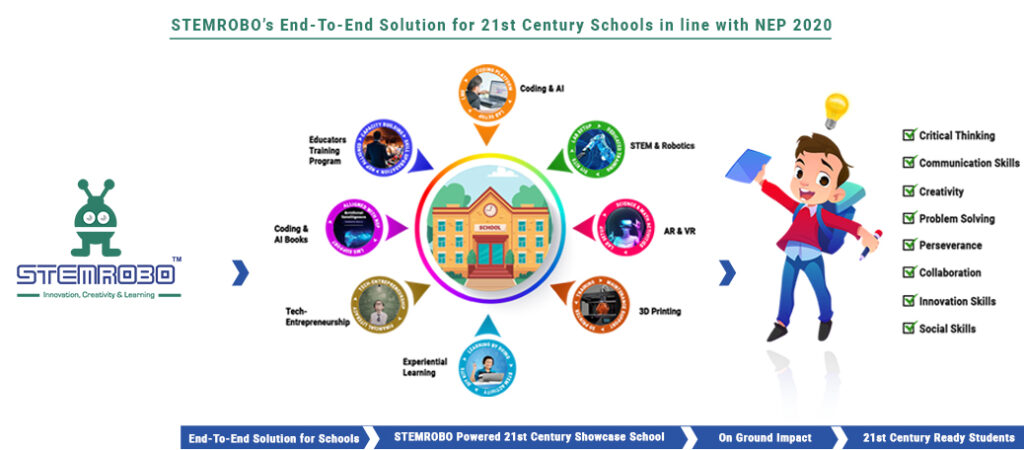
Learning and Innovation skills for students are essential abilities that enable individuals to adapt to a rapidly changing world. These skills include a range of abilities, including creativity, critical thinking, communication, and collaboration. It is necessary that K–12 children acquire these abilities to better equip them for the challenges coming their way in the future. Why Parents Need to Make Their Children Acquire These Skills Parents play a crucial role in helping their children develop learning and innovation skills. By fostering a supportive environment that encourages creativity, critical thinking, communication, and collaboration, parents can help their children acquire these essential skills. Here’s why parents need to prioritize the development of these skills: Preparing for the Future: By developing these skills early on, children will be better prepared to navigate the challenges of an increasingly complex and interconnected world. These skills are not only important for academic success but also for success in all aspects of life. Building Confidence: Developing learning and innovation skills can help children build confidence in their abilities and become more resilient in the face of adversity. These skills enable children to take risks, learn from failure, and persevere in the face of challenges. Encouraging Lifelong Learning: Learning and innovation skills are not just important for academic success; they are also important for lifelong learning and personal growth. By encouraging their children to develop these skills, parents are instilling a love of learning that will benefit them throughout their lives. Creating Opportunities: Children who possess strong learning and innovation skills are more likely to succeed academically and professionally, creating more opportunities for themselves in the future. These skills enable children to think creatively, solve problems, and communicate effectively, making them valuable contributors to society. Why Are Innovation and Learning Skills Important? Memorizing knowledge and following instructions are no longer enough to succeed in the fast-paced world of today. Companies want people who can think critically, adjust to change, and come up with creative solutions to problems. Students who cultivate their learning and creativity abilities improve their academic achievement and set themselves up for future job prospects. How Can Learning and Innovation Skills be Developed? Educators play a crucial role in fostering learning and innovation skills in students. By incorporating project-based learning, problem-solving activities, and collaborative projects into the curriculum, teachers can provide students with opportunities to develop and practice these skills in a meaningful context. Additionally, integrating technology into the learning process can enhance students’ ability to think critically and creatively. Tools such as educational apps, virtual reality simulations, and online collaborative platforms can provide students with new ways to engage with content and solve problems. Schools play a crucial role in nurturing Learning and Innovation skills for students. By creating a conducive environment and implementing effective strategies, educators can help students develop these essential skills. Encourage Curiosity and Exploration: Schools can encourage curiosity by promoting inquiry-based learning and providing opportunities for students to explore topics of interest. Teachers can facilitate discussions, ask open-ended questions, and encourage students to think critically about the world around them. 2. Emphasize Creativity: Schools can foster creativity by incorporating arts, music, and drama into the curriculum. Encouraging students to express themselves creatively helps develop their ability to think outside the box and come up with innovative ideas. 3. Provide Real-World Challenges: Schools can provide students with real-world challenges that require them to think critically and come up with innovative solutions. This could involve projects, case studies, or simulations that simulate real-world problems. 4. Promote Collaboration: Collaboration is key to innovation. Schools can promote collaboration by encouraging group projects and activities that require students to work together towards a common goal. This helps develop their communication and teamwork skills. 5. Integrate Technology: Technology can be a powerful tool for fostering innovation and learning. Schools can integrate technology into the curriculum, providing students with access to educational apps, online resources, and digital tools that enhance their learning experience. 6. Encourage Risk-Taking: Innovation often involves taking risks. Schools can create a safe and supportive environment where students feel comfortable taking risks and trying new things. This helps build their confidence and resilience. 7. Provide Opportunities for Reflection: Reflection is an important part of the learning process. Schools can provide students with opportunities to reflect on their learning experiences, think about what they have learned, and consider how they can apply it in the future. By implementing these strategies, schools can help students develop the innovation and learning skills they need to succeed in school, work, and life. Together, we can empower the next generation to become lifelong learners and innovative thinkers who are ready to tackle the challenges of the future. STEMROBO is at the forefront of providing educational resources to schools, helping foster essential learning and innovation skills in students. Through its innovative tools and programs, STEMROBO is empowering students to develop the skills they need to succeed in the 21st century. 1. Encouraging Exploration and Curiosity: STEMROBO’s resources encourage students to explore new ideas and concepts, sparking curiosity and a passion for learning. 2. Hands-On Learning: By providing hands-on learning experiences, STEMROBO helps students develop problem-solving skills and a deeper understanding of STEM concepts. 3. Fostering Creativity: STEMROBO’s programs encourage students to think creatively, helping them develop innovative solutions to complex problems. 4. Collaboration and Communication: Through collaborative projects, STEMROBO teaches students the importance of teamwork and effective communication, essential skills for success in the modern world. 5. Real-World Applications: STEMROBO’s curriculum is designed to show students how STEM concepts are applied in real-world scenarios, making learning more relevant and engaging. 6. Adaptability and Resilience: STEMROBO teaches students to be adaptable and resilient in the face of challenges, preparing them for the fast-paced and ever-changing world. 7. Future-Ready Skills: By focusing on skills like critical thinking, creativity, and problem-solving, STEMROBO is preparing students for the jobs of the future. STEMROBO’s comprehensive approach to education, encompassing its end-to-end solution for K-12 students and its innovative DIY kits in the innovation lab, is

Learning and Innovation skills for students Read More »

Learning and Innovation skills for students

Learning and Innovation Skills for Students

The 21st Century presents students with new opportunities and difficulties in a fast-changing world. Our kids need to be ready to take on these difficulties and develop into creators and innovators. In considering this, Learning and Innovation skills for students are now necessary for students to succeed in the 21st century. Innovative and learning skills for students cover a wide variety of qualities that go beyond traditional academic knowledge. These abilities enable students to think critically and solve issues, and along with this allow them to actively engage in and retain knowledge. They are the foundation of a versatile and diverse person. Creativity, Critical Thinking, Communication, and Collaboration. These Learning and Innovation skills for students are considered as the foundation of an overall education that equips students for the needs of the 21st-century Skills. In any sector, successful communication is essential to success. Students with strong communication skills, active listening abilities, and teamwork abilities are more likely to succeed in the classroom as well as in the workplace. Teachers need to provide an atmosphere that values open conversation and teamwork to improve students’ communication abilities. Students who participate in group projects, presentations, and other communication-intensive activities improve their capacity to express themselves clearly. Students must be proficient in all modes of expression, including verbal, written, and digital communication, in this day of digital interactions. All these Learning and Innovation skills cannot be learned in a single day, so students must start learning from an early stage. By considering all these needs we at STEMROBO are mainly focusing on Bringing the innovation culture among students at very early stages. We provide a curriculum that goes hand in hand with academics along with delivering Learning and Innovation skills for students, enthusiastic support from our innovation engineers, and many other resources. Students training programs We provide training to students on the latest technologies through various interesting methodologies, by which students can solve real-life problems. Teachers training programs We train school teachers to integrate learning and innovation in regular classroom sessions. Our programs have helped teachers to make their classes more interesting and informative. Project support by Industry Experts Regular technical sessions are provided to students and teachers for exposure to improvise their learning skills. Backend support is provided for various competitions. Assistance and Support Our dedicated team supports the lab execution. We also help schools by using our date–driven process to easily review and document their progress periodically. The most crucial element in preparing kids to become innovators is to foster Learning and Innovation skills for students. At STEMROBO, we offer a variety of labs according to the requirements and grade level of each student. Students can utilize their creative ideas to create various real-world projects and gain practical experiences. Students can bring out their creative potential by using this approach. We offer various kits and tools such as tinker orbits, Robotic kits, Mechatron kits, 3D printers and 3D pens, Arduino kits, and many more. Whenever a student fails to understand a theoretical topic in the classroom, they may utilize these kits to apply that theoretical knowledge in real-world situations. Students also use these kits to build new projects and exercise critical thinking and inventive abilities. In this way, they will be able to understand the concept in-depth which will make their learning journey more effective. The 21st century is a dynamic environment, and for students to succeed, learning and innovation skills are not just desired but also necessary. It is our responsibility as educators, and parents to make sure that the educational system changes in a way that best fosters these abilities. Critical thinking, communication, teamwork, and creativity are all things that we can help kids develop into lifelong learners, creative thinkers, and flexible leaders who can create a better future.

Learning and Innovation Skills for Students Read More »