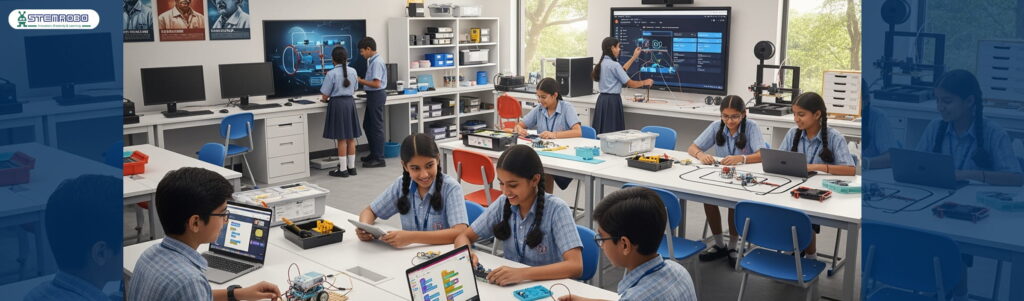
How AI, Robotics, and STEM Are Transforming New-Age Schools
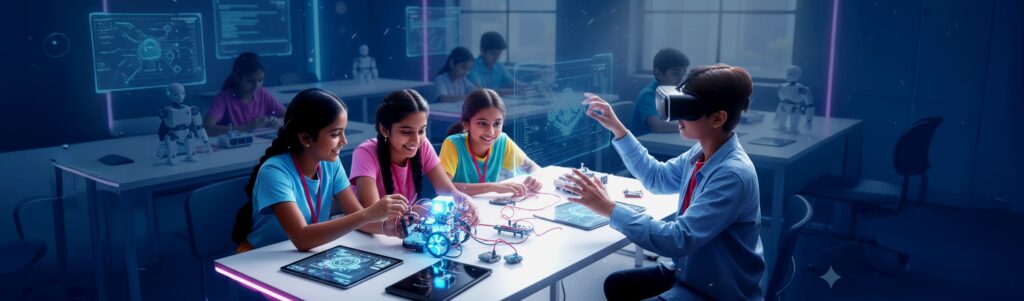
The classroom of today doesn’t always look like the classroom we remember. A group of children is huddled around a table attempting to teach a small robot how to follow a black line. Another child is inquiring of an AI chatbot for children why his Python program is coming back with an error, while a teacher is glancing at a performance dashboard on her laptop to see which topic most of her students found confusing during the last lesson. This is not a scene from science fiction. Slowly, this is becoming the reality of a new age classroom. The process of education is quietly undergoing a revolution. The tried-and-tested method of lectures, textbooks, and sporadic exams is being supplemented by intelligent tools that render the entire experience of learning more personalized and engaging. At the forefront of this revolution are artificial intelligence, robotics and STEM learning. It is through AI classroom tools, AI learning platforms and resourceful robotics labs that schools are beginning to become a place where children are not just accepting knowledge but are instead creating, exploring and innovating. But how is this shift, this alliance of technology and education changing the way we learn, and how children approach their learning with the support of their educators? The Shift Toward Smarter Classrooms For years, a school day looked like this: the teacher taught something to the students, who just took notes and later were assessed on that subject. Though it served education for a good time, the one thing that often failed was how every single student learns differently. Today, schools are implementing intelligent systems for AI tools for teachers, and Generative AI for education. They assist teachers in planning lessons, tracking progress and building activities beyond simple lectures. Instead of waiting to see the results of learning after a term ends, teachers can now track learning behaviors of students with AI learning analytics and student learning analytics in real time. The learning analytics of students and their progress are often represented in an AI education dashboard. This makes it possible to discover struggling students and concepts that need to be reviewed again. Technology is now only beginning to alter its role within the classroom environment, from being a hindrance, to one of benefit. Robotics Making Learning Tangible Robotics labs are an interesting and vital addition to today’s classroom. Instead of looking at facts and theories in books, robots allow children to experience science, math and engineering in a more hands on, fun environment. While assembling components, programming a robotic structure and watching their creation come to life based on their commands, science ceases to be abstract and becomes applicable to their lives. Concepts which may have once been too complex to comprehend become clear as the principles of engineering and coding come to life. A well-managed robotics project also teaches students that learning is a process of trial and error. The robot does not work on the first attempt. The code often comes with syntax errors-this is when the learning truly begins as the student trouble shoots to create a working model. By working to identify a mistake and revise the programming, a student not only learns to fix their robot but also builds confidence and self-efficacy. When the opportunity is given to create and innovate, the classroom is no longer just an abstract idea, but a tangible and exciting source of learning. Artificial Intelligence Supporting Students Artificial intelligence can be a great learning assistant for students. Most of the schools are equipped with AI tutoring software or education chatbot software to help students continue their learning after the school hours. Through these, they are able to ask questions, grasp complex concepts, and get more practice anytime. For instance, if a student is trying to revise an exam topic and encounters difficulty understanding a concept, an AI chatbot for students could immediately give him the required explanation along with a few examples. Additionally, Custom GPTs are now also being introduced in some schools which can assist students as their personal study partner and give explanations in the level they are able to understand. These are never meant to substitute the teacher, but as an additional learning help. Main advantages: Learning Insights Through AI Analytics Another revolutionary aspect of AI in the classroom is learning behavior analysis. Each step taken online, whether it’s watching a video tutorial, trying a quiz question or looking up information about a particular topic, produces valuable information. With education analytics AI and an online learning analytics platform, schools can make sense of all this data, creating learning data. This allows teachers to track which subjects students spend the most time reviewing, where errors in learning often occur and the amount of time it takes to complete certain questions. Predictive learning analytics is also available through AI in education. If a number of students begin to struggle with one topic, teachers can be informed at an early stage, and this potential problem can be dealt with before it becomes serious. This is then viewed through the online education analytics platform and AI education dashboard. It gives teachers access to valuable information so that they can assess teaching methods more accurately. It is about the combination of intuition and data, no longer about one without the other. Smarter Assessments in the Digital Age Tests are also changing, and at the heart of this change is the aid of artificial intelligence. Creating exam papers has historically taken many hours, and often many days for teachers, while now, tools such as the AI question paper generator and the AI test generator tool can formulate assessments in minutes. Teachers will input topics, difficulty level, learning objectives, and the system generates balanced question papers. Some AI systems, the AI assessment software and AI-driven assessment platforms, will go one step further. These platforms employ adaptive assessments AI to control the difficulty of questions during tests, and where the user’s answer is correct, increasing the complexity until, either by error
How AI, Robotics, and STEM Are Transforming New-Age Schools Read More »