Click For Schools

VR Lab Setup Cost for School

VR in Classroom: The Future of Virtual Learning

VR in Classroom: The Future of Virtual Learning

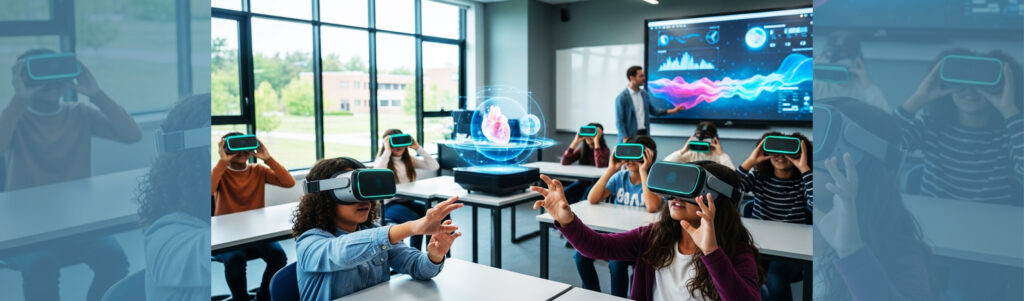
The world is changing fast and it is important that schools also adapt to it in order to make the students ready for the future so that they can get the jobs they want, with ease. There is a trending concept of education going on, that is, virtual reality or more popularly, VR. This blog will help the parents, teachers, schools and all the stakeholders understand the importance and benefits of virtual reality. What is Virtual Reality in Education? Virtual Reality (VR), in simple terms is a three-dimensional environment that is created to make the users feel like they are entering into a totally different surrounding. This is made through computers. With the help of VR gadgets like headsets or other devices, a person can experience a new world, a new experience by just being in one place. VR helps the user to actually understand better through creating a different environment and surrounding. For example:• Learning how earthquakes occur• The beating of a heart• The flow of xylem and phloem• War and war experiences• Exploring planets and galaxiesThese experiences are just a jist, a person can explore as much as they want and however they want, according to their heart’s content.Advantages of Virtual Reality in Education There are many benefits to using VR in traditional education. Some of them are – 1. Makes Learning Engaging and Fun Traditional classes rely on books, pencils, blackboards and 2D images. But when students see and feel the objects, they learn better and understand more. This helps them retain the knowledge longer. 2. Improves Understanding of Complex Subjects Some concepts are difficult to visualize. For example, understanding human anatomy from diagrams can be challenging. With VR, students can virtually “walk through” the human body and see how organs work in real time. 3. Bridges Geographical Gaps Not every student can visit the Great Wall of China or NASA’s space center. But with VR in classroom, these experiences become possible. Students can take virtual field trips across the world without leaving their school. 4. Personalized Learning Each student is different is different and so the teachers can easily customise the lessons according to the needs and wants of the students so that no child is left behind in the pursuit of greatness. 5. Safe Learning Environment Some experiments involve risks and hence using a VR helps nullify those because students are working in a similar environment with no risks. 6. Builds Future-Ready Skills The future wants candidates that are well versed with the practical knowledge, that is, they need to know how things work and function. 7. Encourages Creativity and Innovation It doesn’t only teach the children but also pushes them to be more imaginative and curious. They learn how to think out of the box and also apply their knowledge in a real world situation. VR in Classroom – Real-World Applications The use of VR is not just a desire or a buzzword, it is actually very essential to use its expertise to make the kids well prepared for the future that demands skills more than the theoretical knowledge. they can learn any subject. They can learn history by walking through the establishments and ruins of civilisations, learn about the seven wonders of the world, that is, they can time travel. They can understand better about arithmetic, architecture, the textures of different rocks and also others. The Future of Virtual Learning The future of virtual learning looks promising with the integration of VR in education. 1. Blended Learning Models Schools will combine traditional teaching with VR-based modules. 2. Global Classrooms VR will make global classrooms a reality. A child in India could attend a class with students in the U.S. and Singapore, all Students connected through Virtual spaces. 3. Affordable and Accessible Education As VR technology becomes a cheaper, even rural schools and Colleges will be able to provide high quality learning. experiences. This will reduce inequality in education Sector. 4. Skill Development Beyond Academics VR not only focuses on technical knowledge but also teach the students about the essential 21st century skills like creativity, collaboration, curiosity etc. 5. Preparation for Future Careers The future has jobs that aren’t even there yet and the students who are trained with the VR environment will find it easier to go through the job market. Because they will have more knowledge and practice through the Virtual reality environment. How STEMROBO is Driving the VR Revolution The future is very demanding and hence the students need to be prepared for it. This can be done when they actually learn to enjoy the things they learn, along with understanding them better and retaining them for a longer time.By integration of Virtual Reality in education, students can explore a three dimensional world by just sitting at one place and the best part is that, they are inside that world. That is, they can travel through space, go underwater, explore planets, see how agriculture is done, etc.For example –In Science, a student can explore the human body, see chemical reactions, explore solar system and also see how the organisms work etc.In Maths, students can explore the shapes and sizes, learn arithmetic, that is, they learn geometric better.In Coding & Robotics, students can visualise a finalised product and also do hit and trial runs through Virtual Reality!In Geography, students can explore mountains, the seas and also learn about the soil structures etc Conclusion In today’s education system, virtual education or VR lab is more than just a trend, it is as essential as traditional education. Virtual learning makes learning much more interesting and understandable. Through this, students can easily connect the theoretical knowledge to practical knowledge. This is an example of quality education that makes the students well prepared for the future and its challenges. They also learn the very important 21st century skills that supplement their knowledge.

VR in Classroom: The Future of Virtual Learning Read More »
The Future of Learning is Hands-On: How STEMROBO is Transforming Classrooms in 2025

The Future of Learning is Hands-On: How STEMROBO is Transforming Classrooms in 2025

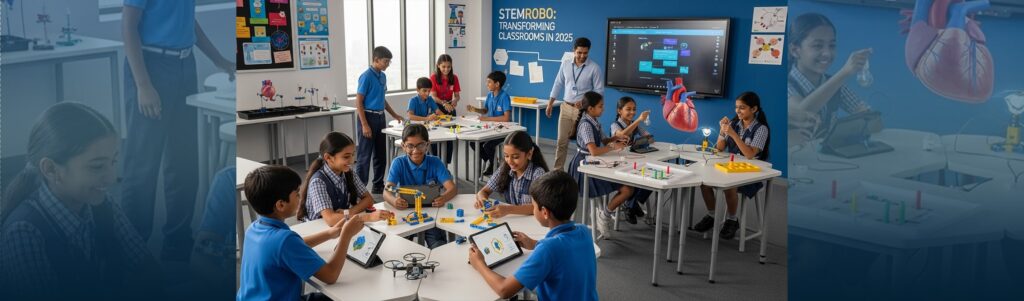
The world is moving fast and faster are the trending words moving. For example – We keep on hearing the word AI, or artificial intelligence almost regularly, everyday. Why is AI a buzzword now? What is AI actually? What is hands-on learning? etc.AI or artificial intelligence means AI or Artificial Intelligence means when machines or systems are trained to replicate human tasks. It is now being actively integrated into school curricula via STEM education, Coding and AI platforms, and Robotics lab making it an essential part of modern learning.  AI is now used extensively to help minimise the human efforts in the everyday repetitive tasks. Let us dive deep into this magical technology! Why Hands-On Learning Matters When children learn to do the stuffs by themselves, they learn better and retain more. This also helps them develop skills of 21st century skills and this help them navigate better and make better decisions.  This approach: With these innovation labs, schools are providing students with tools to learn by doing, integrating STEM, AI, Robotics, and coding into their everyday curriculum. Introducing STEMROBO Labs This Educational Technology Company’s Labs are a wholesome solution for modern classrooms that combine both traditional knowledge and modern education of robotics, STEM, AR/VR and AI, complete solution for modern classrooms, combining technology, creativity, and innovation. These help a student to learn better and retain longer. By combining these areas, they are connecting the threads of theory and practical knowledge that equips students to make themselves equipped for the future and its jobs. How are these innovation labs Transforming Classrooms 1. Making Learning Interactive and Fun In these innovation hubs, students don’t just listen, they learn and learn to create inventions that contribute to the society in the best way possible.for example –Instead of just imagining how xylem and phloem works, through AR/VR a student can imagine better and this helps them to understand things quicker and better. 2. Encouraging Creativity and Innovation Stem innovation and learning Centre encourages the students to explore their creativity and discover their potential and interest. In this way, they’ll be able to pinpoint their passion and upgrade and polish their skills accordingly 3. Building Essential Life Skills Future doesn’t mean only technical skills but also the essential 21st century skills. And 21st century skills in education are very mandatory to being future-ready These skills are equally important as academic knowledge, giving students a head start in life and careers. 4. The Power of STEM Education What helped these students succeed wasn’t just an idea, it was the accumulated contributions of a learning environment which encouraged them to explore their curiosity, the endless possibilities and build practical solutions. This is what STEM education is truly about, not just learning science and technology from books, but applying that knowledge in real-world scenarios. Through STEM project-based learning, students don’t just learn what to think; they learn how to think. They learn to push past their potential. The moment they connected the dots between a dripping tap and environmental damage, they weren’t just solving a plumbing issue. They were building awareness, responsibility, and impact. And that’s how small projects become big lessons. STEMROBO and National Education Policy (NEP 2020) India’s NEP 2020 emphasizes holistic, experiential, and skill-based learning. These Labs align perfectly with this vision by: By implementing these Labs, schools are not only complying with NEP 2020 guidelines but going beyond, creating a truly innovative learning environment. Real-World Applications of Stem education consulting Company in India:-Modern education helps students connect their learning to the usage of it practically. They learn to think in a systematic way through design thinking and find solutions. Examples include: Teachers training programAs much as it is important for kids to be well equipped with this segment, it is also important for the teachers also be well equipped so that they can help guide the kids successfully. There are Certified Educators Program for teachers, provided by this Coding and AI Platforms providers Company The STEM Education Solution Providers Company’s Advantage – Schools implementing these Labs report higher engagement, better academic outcomes, and more confident students, highlighting the transformative power of hands-on learning. Parent Perspective: Parents want the best for their kids and they want an education that makes them ready fro the future and their ventures . These Labs address these needs by giving students real-world exposure and practical skills, ensuring they don’t just learn, they innovate. Conclusion: Building the Innovators of Tomorrow Schools and AI : Now that the technology is rapidly upgraded, so is the education; to make the students ready for the future. Schools are now integrating AI and coding as a subject. This ensures that students can retain the knowledge for a long time. This happens because they indulge in ‘learning-by-doing’. Students also develop the necessary 21st century skills like critical thinking, curiosity etc. Many schools are integrating PM Shri TLM Kits, Math Kit PM Shri School, and AI and IoT Learning Solutions for schools to align with the K12 Segment Solutions for Schools approach. They also learn about the real life problems and try to solve them through the design thinking process of – Also, the best thing is that government is now acknowledging this groundbreaking change and supporting AI and robotics education for Schools. Government has taken initiatives to equip students with the 21st Century skills, promote stem education and encourage them to solve real world problems.

The Future of Learning is Hands-On: How STEMROBO is Transforming Classrooms in 2025 Read More »

AR VR Training Program

Create your Digital AR VR Classroom

Building Your Own Digital AR VR Classroom: Using Immersion Technology to Improve Learning With technology at the forefront of a revolution in traditional teaching techniques, the education industry has seen a tremendous transition in recent years. Virtual reality (VR) and augmented reality (AR) have become game-changers among the numerous technological advances, providing creative methods to engage students and improve their learning experiences. Let us examine the idea of Creating Your Digital AR VR Classroom and go over its advantages for teachers and students. Understanding AR and VR It’s important to understand the fundamentals of these technologies before entering into the technical aspects of Creating Your Digital AR VR Classroom. Augmented Reality (AR) improves our sense of reality by putting digital information over our real-world environment. Conversely, virtual reality (VR) isolates people from the outside world by submerging them in a fully simulated environment. Both of these technologies have the power to revolutionize how we engage with and learn from information. AR and VR’s advantages for education There are several advantages to incorporating AR and VR into education, such as: Enhanced Engagement: Students’ attention is captured and their drive to learn is increased by AR and VR experiences, which are fundamentally more engaging than traditional teaching techniques. Better Retention: Compared to typical classroom settings, interactive experiences in augmented reality and virtual reality have been found to improve the retention of knowledge. Interactive Learning: These technological advancements make it possible for students to engage in hands-on, conceptual exploration. Accessibility: By giving students with disabilities new opportunities to interact with instructional information, augmented reality, and virtual reality can improve accessibility to learning. Creating AR VR classrooms for K–12 institutions may completely transform how students engage with and learn from educational resources. Schools can provide students personalized, immersive, and engaging learning experiences that improve academic achievement and set them up for future success by utilizing the advantages of AR and VR technologies. Both students and teachers may gain many benefits by integrating augmented reality (AR) and virtual reality (VR) into K–12 education. 1. Increased Involvement Because AR and VR technologies offer immersive and interactive learning environments, they may greatly increase student engagement. Students’ learning may become more engaging and enjoyable with the help of these technologies, which will boost their interest and involvement in class activities. 2. A better comprehension of difficult concepts By giving students a more physical means to visualize abstract ideas, augmented reality, and virtual reality can aid students in understanding complicated subjects. For instance, students can use augmented reality to analyze virtual frogs and virtual reality to explore the solar system and learn about planetary motions. 3. Tailored Education Students may have individualized learning experiences using AR and VR as they can study at their own speed and in the way that best suits them. To assist students achieve better learning outcomes, educators can construct situations and learning materials that are specifically matched to each student’s requirements. 4. Reaching Difficult or Unreachable Places Students can have access to far-off or unreachable places, such as historical sites, museums, or space, thanks to augmented reality and virtual reality. giving children the chance to explore locations they may not otherwise have the chance to see, might enhance their educational experience. 5. Better Cooperation and Exchange of Information By allowing students to collaborate on projects and exchange ideas in a virtual setting, augmented reality and virtual reality may foster communication and teamwork among students. Important social and collaborative abilities that are necessary for success in the future can be developed in this way. 6. Practical Uses Because AR and VR simulate real-life situations, they can aid students in understanding how their learning relates to the actual world. For instance, students may learn about environmental conservation through interactive simulations or hone their problem-solving abilities in a realistic commercial setting. 7. Cost-Effectiveness While the initial investment in AR and VR technology may be significant, it can be cost-effective in the long run. These technologies can eliminate the need for expensive field trips and physical learning materials, saving schools money over time. STEMROBO is a company that specializes in providing educational solutions that integrate STEM (Science, Technology, Engineering, and Mathematics) education with robotics and other cutting-edge technologies. STEMROBO provides a variety of educational resources and services aimed at assisting schools in creating digital AR VR classrooms and improving student learning. STEMROBO provides educational kits that incorporate AR and VR elements, enabling students to learn about AR and VR technologies while building and programming their own robots. With the use of these kits, students may gain practical experience and comprehend the fundamentals of AR and VR. Curriculum Development: STEMROBO creates lesson plans for STEM subjects that use AR and VR technologies. These teaching materials are intended to support educators in successfully incorporating AR and VR into their classes while remaining responsive to academic requirements. Teacher Training: To assist educators in integrating AR and VR technology into their classrooms, STEMROBO offers training courses for teachers. These courses address things like creating AR and VR material, using AR and VR technologies, and incorporating AR and VR into the classroom. Development of AR and VR Content: STEMROBO produces AR and VR content with an emphasis on education. With the use of interactive courses, virtual labs, and simulations, students may study difficult subjects in a way that is more interesting and immersive. Technical Assistance: STEMROBO provides technical assistance to schools that are integrating AR and VR technologies into their courses. This support includes help with integrating AR and VR into the current technological infrastructure, addressing technical challenges, and setting up AR and VR equipment. With all factors considered, STEMROBO is making a significant contribution to the creation of digital AR VR classrooms in schools by giving them access to the required equipment, content, support, and training. Through these initiatives, STEMROBO is assisting in improving students’ educational experiences and preparing them for the workforce of the future.

Create your Digital AR VR Classroom Read More »

AR VR Training Program

AR VR Training Program

Training Program for Augmented and Virtual Reality: Transforming Education in the Digital Age Technology has completely changed how we work, study, and engage with the world in recent years. In this field, the rise of Virtual Reality (VR) and Augmented Reality (AR) technology is one of the most remarkable advancements. Immersive technologies are transforming the training environment by providing new opportunities for interesting, dynamic, and productive learning experiences. Recognizing AR and VR Let’s first review the definitions of AR and VR technologies before getting into the specifics of training programs. The term “augmented reality” (AR) describes how digital data is integrated in real-time with the user’s physical surroundings. Usually, to do this, one uses an AR glass, tablet, or smartphone to project digital material onto the real environment. On the other hand, Virtual Reality (VR) confines people from the outside world by immersing them in an entirely replicated environment. Typically, a VR headset—which offers a 360-degree perspective of the virtual world—is used to do this. Benefits of AR and VR Training Programs AR and VR training programs have several advantages over traditional teaching techniques. The capacity to design incredibly realistic and immersive learning experiences is one of the main benefits. This may be especially helpful in industries where hands-on knowledge is crucial. For K–12 students, AR and VR training programs have several advantages. The capacity to design incredibly captivating and immersive learning experiences is one of the main benefits. Learning may become more engaging and simpler by using these technologies to bring concepts to life in a way that is not possible with traditional teaching approaches. Adapting to various learning methods is a significant advantage as well. Visual, auditory, and kinesthetic learners may all be accommodated by AR and VR technology, giving each student a more customized learning experience. Retention rates and learning outcomes may both benefit from this. Programs for teaching students AR and VR can also aid in the development of their critical thinking and problem-solving abilities. Students can gain a deeper knowledge of subjects by actively exploring them via hands-on activities in virtual settings. One further significant advantage is the capacity to offer customized educational opportunities. When necessary, AR and VR technologies may adjust to the individual’s knowledge and skill level to offer more challenges or help. Both learning results and engagement levels may benefit from this. Additionally, AR and VR training programs can be more cost-effective and scalable than traditional training methods. They eliminate the need for travel and physical training materials since they can be quickly and readily distributed to a large number of users. Future of Learning in the Digital Age Learning appears to be becoming more digital and immersive as AR and VR technologies advance. These innovations have the power to completely transform training and education by creating exciting possibilities for individualized, interesting, and productive learning experiences. We might expect more industries to adopt AR and VR training programs in the upcoming years. An increasing number of organizations will use these technologies to improve their training offerings as they become more accessible and inexpensive. Application in Classrooms There are several uses for AR and VR training programs in K–12 education. As an example, in science classrooms, students may study difficult science concepts like the solar system or the human body using augmented reality and virtual reality technologies. This may contribute to more interactive and interesting learning, which improves knowledge retention. Students may immerse themselves in the past by using AR and VR technology in history lessons to recreate historical events or locales. This may help make history more relevant and interesting for students by bringing it to life in a way that textbooks cannot. Integrated language learning can be improved in language classrooms through the use of AR and VR technologies. By allowing them to look into virtual environments where a specific language is spoken, students may improve their language abilities more engagingly and naturally. All things considered, AR and VR training programs are changing the way we learn by providing new opportunities for interesting, dynamic, and productive learning experiences. These technologies have the power to completely transform training and education as they develop further, opening the door to a more digital and immersive learning environment in the future. STEMROBO focuses on offering educational resources for STEM (Science, Technology, Engineering, and Mathematics) learning, specifically for robotics education. In addition to fostering the development of technical, problem-solving, and critical thinking abilities in students, STEMROBO provides a variety of products and programs that present STEM ideas interactively and engagingly.  In the realm of augmented reality (AR) and virtual reality (VR) education, STEMROBO’s objective is to give students practical learning opportunities that make use of these immersive technologies. STEMROBO provides dynamic and engaging educational solutions that use AR and VR to make complicated subjects easier for students to comprehend. With the AR and VR programs from STEMROBO, students may perform experiments in a safe and controlled environment, interact with digital objects, and explore virtual surroundings. STEMROBO helps students acquire the technical, critical thinking, and problem-solving abilities necessary for success in the digital era by incorporating AR and VR into their curricula. STEMROBO offers AR and VR programs that can be customized for various age groups and academic levels, allowing students ranging from elementary school to high school to utilize them. As a result, students may get an early start on their foundation in AR and VR technologies, setting them up for future education and opportunities in related industries. All things considered, STEMROBO is essential to the advancement of AR and VR education since it gives students the resources and tools they require for studying these immersive technologies and developing a greater understanding of STEM subjects.

AR VR Training Program Read More »

AR VR Curriculum for Schools

AR VR Curriculum for Schools

The use of technology in education has become essential in preparing students for the challenges and opportunities of the 21st century. Two cutting-edge technologies, augmented reality (AR) and virtual reality (VR), have the potential to transform the way students relate to their academic environment and acquire knowledge. As educators work to create engaging and dynamic learning environments, developing an AR-VR curriculum for schools seems like a progressive and forward-thinking idea. The way that education is taught is changing dramatically as augmented reality (AR) and virtual reality (VR) Curriculum for schools has become more and more prevalent in classes. The educational advantages of AR-VR curriculum for schools especially students in the classroom go beyond the boundaries of the traditional learning environment, offering a cutting-edge and successful method of learning that meets the needs of today’s world. These technologies have the potential to significantly change education in the future as long as they keep developing. Real-World Application: Students may apply their academic knowledge to actual problems by using AR and VR to simulate situations from the real world. To improve their knowledge and memorization of subjects, students might, for example, get involved in virtual workplace environments, visit historical locations, or do virtual science experiments. Getting Ready for Your Future Career: Students are introduced to widely utilized technology in a variety of industries through the integration of AR-VR curriculum for schools. Their experience gives them a competitive advantage in the job market and prepares them for future careers in disciplines like engineering, design, medicine, and virtual collaboration. Development of Skills: Using AR and VR apps fosters the development of many different kinds of skills, such as decision-making, problem-solving, and critical thinking. As they explore and interact with virtual environments, AR-VR curriculum for schools also improve student’s understanding of technology, equipping them for the technologically advanced jobs of the future. Global Connectivity: Through the AR-VR curriculum for schools, Students can study by being at any location and can communicate with other students worldwide through virtual collaborations, which promote cooperation and communication across cultural boundaries. This prepares students for a globalized environment where the capacity to collaborate with various people is a necessary talent. Excitation for learning: AR-VR curriculum for schools makes learning more exciting for students. With the use of devices like VR headsets and AR virtual displays, students find it interesting to study by watching instead of simply reading textbooks. This increased interest may result in a more positive perspective on learning, encouraging creativity and growth. At STEMROBO, we provide K–12 students with end-to-end solutions by giving them access to VR labs and resources that enable teachers to effectively teach children about any subject. For integrating the AR-VR curriculum for schools, we provide our in-house app called STEMROBO AR, it is an app through which students can visualise any picture in 3D that is drawn on paper. Along with this, we also provide Tinker N Design kits in which we have included several customized sheets on which different types of pictures are drawn.   We have designed that picture on the paper in such a way that when a student uses our app and places the camera on the paper it will automatically show the picture in 3D form. By accepting the integration of AR and VR into the school curriculum, we are embarking on a revolutionary path that will lead to an educational journey that is more impactful, personalized, and engaging. The potential for increased involvement, practical application, diversity, and global interaction places AR and VR in a unique position to help students become ready for the challenges of the 21st century.

AR VR Curriculum for Schools Read More »

AR VR Education in Schools

The Future of AR VR Education in Schools

Education in the upcoming future will be based on advanced Technologies like AR (Augmented Reality) and VR (Virtual Reality). These two cutting-edge technologies have created a positive impact on our educational system. Integrating AR/VR-based instruction in the present curriculum has several advantages, such as: Children of today want to learn either by doing practically or by visualizing things in the real world; they are not that much interested in studying from textbooks. students of new age desire to learn everything by doing or by observing things in the real world so they tend to retain knowledge for a longer time. As an example, if we watch an animated cartoon with them and ask them a question about a particular scene, they will be able to answer us very easily. However, if we give them a book with a story in it, they won’t be able to respond to us with the full answer because their minds learn things more quickly from watching than from reading. AR is a platform that takes students on a virtual trip so that they can get an in-depth knowledge of a particular subject. The potential of AR and VR Education to create incredibly exciting and engaging learning environments is one of its main benefits for education. Passive learning occurs when teachers are unable to hold students’ attention in traditional classroom settings. With the use of 3-D models, virtual field trips, and interactive experiments, AR and VR technologies make learning more engaging for students. In addition to developing deeper knowledge, this experiential learning method inspires students’ curiosity and makes learning enjoyable. STEMROBO plays an important role in transforming traditional education into new educational methods by providing various platforms that offer end-to-end solutions to K -12 Students. We offer an engaging learning environment, where students can utilize the equipment and can practice Hands-on learning, this helps them to apply the theoretical knowledge to real-world applications. Let us see how our labs may transform this educational system and how successful they are: We set up a variety of labs including VR labs, AI/IoT labs, Robotics labs, and STEM labs. In addition to these labs, we give students access to resources like VR headsets, Arduino kits, and other necessary equipment in one convenient location, enabling them to learn efficiently and quickly. We also provide different types of instruction manuals so students may follow the step-by-step procedure and build creative projects. We provide students with a customized learning environment that helps them to study according to their speed, level of understanding, and ability to learn the concept. It helps in the development of the 21st century skills including computational thinking, creativity, logical reasoning, problem-solving, and teamwork. AR/VR technologies have the capacity to revolutionize education by catering to individual learning styles. With these advanced technologies, we can give each student a platform based on their interests, capacity to learn, and speed. Our goal is to support K–12 children worldwide in developing their innovative and 21st-century skills. We provide students with incredible opportunities to study, explore, and experiment in order to develop into future creators and innovators. We follow a CIC (Consumer>Innovator>Creator) approach. With the help of our knowledgeable teachers and VR labs, we first teach students concepts in the classroom. Later, they apply what they have learned in the classroom to our labs, which helps them create creative projects and improves their academic performance because visualizing concepts helps them retain them for longer. They will now be able to design their own projects and acquire non-academic skills through this technique, preparing them for the workforce of the future.

The Future of AR VR Education in Schools Read More »