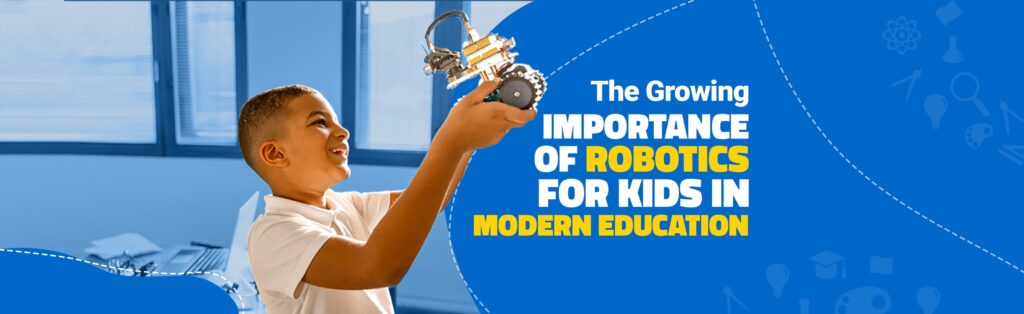
The Growing Importance of Robotics for Kids in Modern Education
What are robots and robotics? Robots are physical machines that perform tasks to ease the life of humans and robotics is the field of study that designs, invents and programs. It combines the concept of science, mathematics, technology, engineering, i.e, STEM and also AI, to develop unique robots to make our lives easier With the advancement of time and technology, we are leaning more towards the comfort that the presence of robots provide. From the time we get up, scroll our phones to the time we head back to our beds, we are subconsciously surrounded by robots at every second second of our day. If we want to prepare kids for this future, we need to rethink how we teach them. Traditional education has served us well, but it’s no longer enough. Kids today need more than just books and tests. They need to learn how to think critically, solve problems, and create. And this is exactly where robotics education comes into play. Imagine a classroom where students aren’t just memorizing equations or listening to lectures. Instead, they’re building and programming their own robots — learning through action, collaboration, and real-world problem-solving. This isn’t a futuristic fantasy. It’s happening now, and it’s changing the game for education. Atal Tinkering Labs (ATLs) are government-initiated innovation spaces in schools, designed to foster creativity and hands-on learning in STEM fields like robotics, coding, and electronics. These AI and Robotics labs, part of the Atal Innovation Mission, aim to develop problem-solving skills and prepare students for a technology-driven future and provide Robotics labs for schools. Let’s explore how robotics is empowering kids to become the leaders, innovators, and problem-solvers of tomorrow. FROM THOUGHTS TO THINGS Traditional classrooms are often only equipped with the blackboard and the teacher who most probably fails to engage the whole of the class . In today’s fast-paced, tech-driven world, where competition is getting more tense, simply just going for class and doing homeworks just doesn’t work well. Students need dynamic, hands-on education that prepares them for the rapidly evolving world of technology and innovation. This is where robotics education comes into play Traditional classrooms are designed around a passive learning model, where students listen to a teacher and absorb information. But this approach doesn’t always translate well in today’s fast-paced, tech-driven world. The future demands that kids don’t just absorb knowledge — they need to actively apply it. This is where robotics and coding for kids steps in. What is Hands – on learning? Robotics and AI Curriculum for schools is a game-changer because it turns students from passive learners into active creators. Instead of just learning about how things work, kids get the chance to roll up their sleeves and actually build something that works. Imagine a group of students sitting together, coding a robot to move or figuring out how to fix a broken sensor. They aren’t just memorizing facts — they’re problem-solving in real time, trying new ideas, failing, and then trying again. This develops their resilience and their persistence. They get ready for challenges ahead of them and to enjoy also the journey and embrace their failures with full heart and mind This type of hands-on, project-based learning is engaging, exciting, and — most importantly — memorable. Kids don’t forget what they’ve built and the challenges they’ve overcome. Robotics gives them a tangible way to apply everything they learn in school to create something meaningful. That’s the beauty of robotics — it makes abstract concepts real Problem-Solving and Innovation: The Heart of Robotics Education What makes robotics education truly special is the way it nurtures problem-solving skills. In robotics, there’s no one-size-fits-all solution. Every design is unique, and every robot faces different challenges. That’s why students must become innovative thinkers. They need to come up with creative ways to solve problems. Let’s say a student is building a robot to follow a path. At first, the robot works fine — but then it starts veering off course. The student quickly learns that the sensors need recalibration or that a different algorithm might be needed to guide the robot more accurately. This is real-world problem-solving in action. Robotics teaches students that problems aren’t obstacles, they’re opportunities to learn and improve. The more challenges a student faces, the more creative they become. And here’s the thing: innovation is contagious. As kids work together on their robots, they feed off each other’s creativity and learn how to tackle challenges in new ways. They begin to see obstacles as chances to innovate — a mindset that will serve them well in any career, whether they go into technology, business, or any other field. Shaping the Innovators of Tomorrow It’s not just about building robots — it’s about building future innovators. The world is evolving at an unprecedented pace, and the next generation of leaders will need to be comfortable with change, creativity, and adaptability. Robotics education provides the perfect environment for kids to develop these traits. Think about the next big breakthroughs in fields like artificial intelligence, healthcare, or environmental sustainability. Many of these breakthroughs will be driven by kids who are learning robotics today. They might not realize it yet, but the students designing their first robot today could very well be the engineers, scientists, and entrepreneurs solving the world’s biggest problems in the future. Robotics: More Than Just STEM It’s easy to think of robotics as a STEM subject (Science, Technology, Engineering, and Mathematics). And yes, robotics teaches kids about coding, engineering, and algorithms. But it’s so much more than that. Robotics also fosters creativity, collaboration, and emotional intelligence. These are the qualities that will drive success in tomorrow’s world. Take teamwork, for example. Most robotics and AI projects require students to work together in small groups. They need to communicate, delegate tasks, and combine their skills to get the job done. In the process, they learn how to listen to each other’s ideas, provide constructive feedback, and resolve conflicts. These skills are just as important
The Growing Importance of Robotics for Kids in Modern Education Read More »