Click For Schools

AI and Robotics Education

AI and Robotics education 0

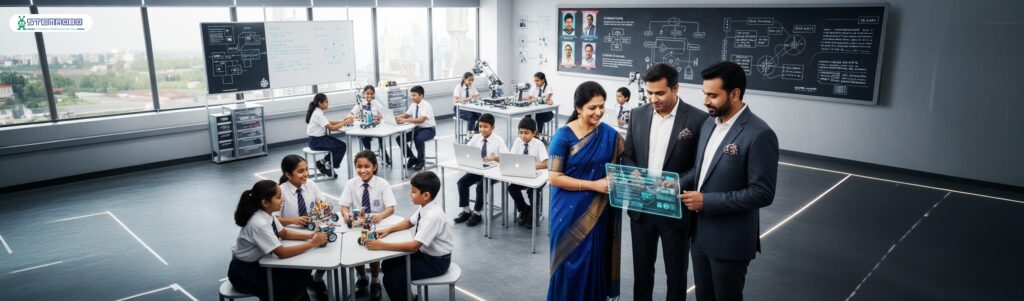
AI and Robotics Education for K-12 Schools: A Complete Guide for School Leaders

Education has evolved beyond traditional methods which required students to study from textbooks and take tests while memorizing information. Students today will enter a world which operates through Artificial Intelligence and automation technologies and robotic systems and smart technologies that exist in all areas of existence. The use of AI technology extends from the child who holds a smartphone to the traffic control systems that operate in metropolitan areas. School leaders must determine whether their educational programs teach students for the upcoming future or for a past educational system that no longer operates. AI and robotics education is not about adding another subject to an already busy timetable. It is about changing the complete process through which students develop their thinking skills and solve their problems while creating their solutions. The organization aims to provide people with all necessary technical resources so they can develop their full potential. Why AI and Robotics Matter More Than Ever Artificial Intelligence and robotics exist in modern society as operating technologies that people use today. The healthcare sector and agricultural field and financial industry and manufacturing sector and transportation system all increasingly rely on automated systems which use data analytics for their operations. The students who learn to operate technology will find work but those who know its inner workings will become industry leaders. The introduction of AI and robotics to K-12 education helps students acquire logical thinking and creative skills together with teamwork abilities and structured problem-solving techniques. They learn how to break down complex challenges into smaller parts and design solutions step by step. The students develop self-assurance to test new ideas while creating fresh solutions. The purpose of education should focus on developing thinkers who can succeed beyond standardized tests. Moving Beyond Passive Learning The traditional classroom system conducts its educational work through theoretical teaching. Students read machine content and algorithm content and system content but they never gain actual experience. The introduction of AI and robotics education enables students to participate in active learning through their exploration activities. Students in the classroom environment create a robot through assembly work and program work to develop its obstacle navigation capabilities. Students learn machine learning through direct experience because they build and train a basic AI system to identify different visual elements. The experience of seeing their programming work properly enables students to create enduring learning knowledge. This method of learning enables students to keep information better while showing enhanced interest and commitment to their studies. The process of learning from failure has been transformed. In robotics labs, mistakes are not setbacks, they are stepping stones toward better solutions. The mindset development prepares students to meet actual life situations. What Should a Strong AI and Robotics Program Include? An effective K-12 educational program requires AI and robotics content to be organized into structured educational paths that suit various student development stages. Primary students should start their learning journey through basic logical sequencing and simple coding activities and beginner robotics kits which provide educational content through interactive learning. At the middle school level, students progress to block programming which uses sensors and enables them to work on small automation projects. The secondary education level provides students with AI development opportunities through Python programming and machine learning and IoT system development and real-world problem-solving activities. The key to achieving goals requires establishing a constant process. Yearly skills development requires students to learn new knowledge and abilities through ongoing training which builds on their existing competencies. A well-designed curriculum enables students to advance from basic logic knowledge to intelligent system design capabilities. Infrastructure serves as a vital component which supports operations. A proper robotics and AI lab requires more than equipment because it needs to provide space which supports testing new ideas. Innovation opportunities arise from using robotics kits together with microcontrollers and sensors and AI platforms and IoT modules. The outcome depends on factors beyond hardware installation according to the statement. The system requires both structured lesson plans and curriculum mapping and ongoing support throughout the process. The Changing Role of Teachers People raise questions about AI and robotics systems replacing teachers in educational settings. The answer is simple no. Technology does not replace educators because it works to empower them. AI-enabled classrooms require teachers to transform into facilitators who will assist students in learning through innovative activities. The teacher conducts classroom discussions while demonstrating to students how their schoolwork connects to real-world situations and through his questions he helps students develop deeper understanding. Teacher training functions as the essential element which enables this transformation. Educators in this program need to develop confidence for three specific areas which include using AI tools and overseeing project-based learning and guiding students through their research activities. Teachers discover technology advantages after receiving complete training because they learn to use technology instead of facing technical problems. Integration Across Subjects AI and robotics should not remain isolated subjects. Their actual strength exists in their combination with other subjects. Students in mathematics classes learn to use algorithms together with data analysis methods. Students in science classes study automation systems and environmental monitoring systems. Social studies classes explore ethical considerations of artificial intelligence and smart city technology. Even in language classes, students can document projects and present innovations effectively. This interdisciplinary method shows students that technology functions as a solution to different problems instead of being only an ability to operate technical equipment. Planning for Sustainable Implementation School leaders need to conduct detailed planning work which should take place before they start implementing their upcoming AI and robotics program. Schools need to assess their complete infrastructure requirements while determining their budget needs and curriculum development requirements and safety regulations and technical support needs. Schools should establish AI integration as their long-term strategic approach instead of treating it as a short-term enhancement. Many institutions select complete implementation partners who provide educational program development and laboratory installation and instructor development and ongoing support throughout one unified system. The platforms Stemrobo Technologies Smartly provide

AI and Robotics Education for K-12 Schools: A Complete Guide for School Leaders Read More »

The Future of Learning is Hands-On: How STEMROBO is Transforming Classrooms in 2025

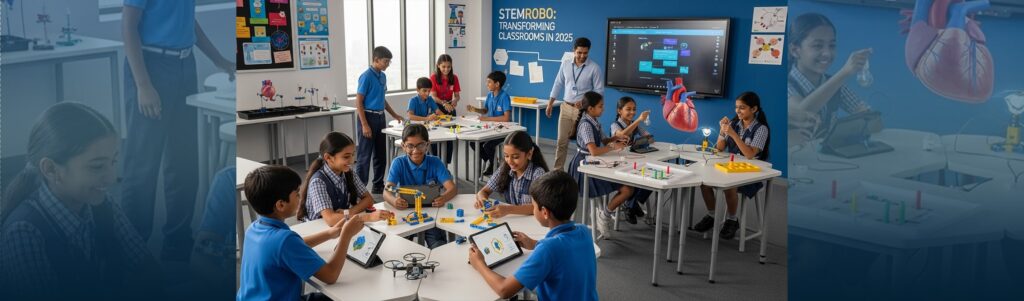
The Future of Learning is Hands-On: How STEMROBO is Transforming Classrooms in 2025

The world is moving fast and faster are the trending words moving. For example – We keep on hearing the word AI, or artificial intelligence almost regularly, everyday. Why is AI a buzzword now? What is AI actually? What is hands-on learning? etc.AI or artificial intelligence means AI or Artificial Intelligence means when machines or systems are trained to replicate human tasks. It is now being actively integrated into school curricula via STEM education, Coding and AI platforms, and Robotics lab making it an essential part of modern learning.  AI is now used extensively to help minimise the human efforts in the everyday repetitive tasks. Let us dive deep into this magical technology! Why Hands-On Learning Matters When children learn to do the stuffs by themselves, they learn better and retain more. This also helps them develop skills of 21st century skills and this help them navigate better and make better decisions.  This approach: With these innovation labs, schools are providing students with tools to learn by doing, integrating STEM, AI, Robotics, and coding into their everyday curriculum. Introducing STEMROBO Labs This Educational Technology Company’s Labs are a wholesome solution for modern classrooms that combine both traditional knowledge and modern education of robotics, STEM, AR/VR and AI, complete solution for modern classrooms, combining technology, creativity, and innovation. These help a student to learn better and retain longer. By combining these areas, they are connecting the threads of theory and practical knowledge that equips students to make themselves equipped for the future and its jobs. How are these innovation labs Transforming Classrooms 1. Making Learning Interactive and Fun In these innovation hubs, students don’t just listen, they learn and learn to create inventions that contribute to the society in the best way possible.for example –Instead of just imagining how xylem and phloem works, through AR/VR a student can imagine better and this helps them to understand things quicker and better. 2. Encouraging Creativity and Innovation Stem innovation and learning Centre encourages the students to explore their creativity and discover their potential and interest. In this way, they’ll be able to pinpoint their passion and upgrade and polish their skills accordingly 3. Building Essential Life Skills Future doesn’t mean only technical skills but also the essential 21st century skills. And 21st century skills in education are very mandatory to being future-ready These skills are equally important as academic knowledge, giving students a head start in life and careers. 4. The Power of STEM Education What helped these students succeed wasn’t just an idea, it was the accumulated contributions of a learning environment which encouraged them to explore their curiosity, the endless possibilities and build practical solutions. This is what STEM education is truly about, not just learning science and technology from books, but applying that knowledge in real-world scenarios. Through STEM project-based learning, students don’t just learn what to think; they learn how to think. They learn to push past their potential. The moment they connected the dots between a dripping tap and environmental damage, they weren’t just solving a plumbing issue. They were building awareness, responsibility, and impact. And that’s how small projects become big lessons. STEMROBO and National Education Policy (NEP 2020) India’s NEP 2020 emphasizes holistic, experiential, and skill-based learning. These Labs align perfectly with this vision by: By implementing these Labs, schools are not only complying with NEP 2020 guidelines but going beyond, creating a truly innovative learning environment. Real-World Applications of Stem education consulting Company in India:-Modern education helps students connect their learning to the usage of it practically. They learn to think in a systematic way through design thinking and find solutions. Examples include: Teachers training programAs much as it is important for kids to be well equipped with this segment, it is also important for the teachers also be well equipped so that they can help guide the kids successfully. There are Certified Educators Program for teachers, provided by this Coding and AI Platforms providers Company The STEM Education Solution Providers Company’s Advantage – Schools implementing these Labs report higher engagement, better academic outcomes, and more confident students, highlighting the transformative power of hands-on learning. Parent Perspective: Parents want the best for their kids and they want an education that makes them ready fro the future and their ventures . These Labs address these needs by giving students real-world exposure and practical skills, ensuring they don’t just learn, they innovate. Conclusion: Building the Innovators of Tomorrow Schools and AI : Now that the technology is rapidly upgraded, so is the education; to make the students ready for the future. Schools are now integrating AI and coding as a subject. This ensures that students can retain the knowledge for a long time. This happens because they indulge in ‘learning-by-doing’. Students also develop the necessary 21st century skills like critical thinking, curiosity etc. Many schools are integrating PM Shri TLM Kits, Math Kit PM Shri School, and AI and IoT Learning Solutions for schools to align with the K12 Segment Solutions for Schools approach. They also learn about the real life problems and try to solve them through the design thinking process of – Also, the best thing is that government is now acknowledging this groundbreaking change and supporting AI and robotics education for Schools. Government has taken initiatives to equip students with the 21st Century skills, promote stem education and encourage them to solve real world problems.

The Future of Learning is Hands-On: How STEMROBO is Transforming Classrooms in 2025 Read More »

Platforms for AI and Robotics

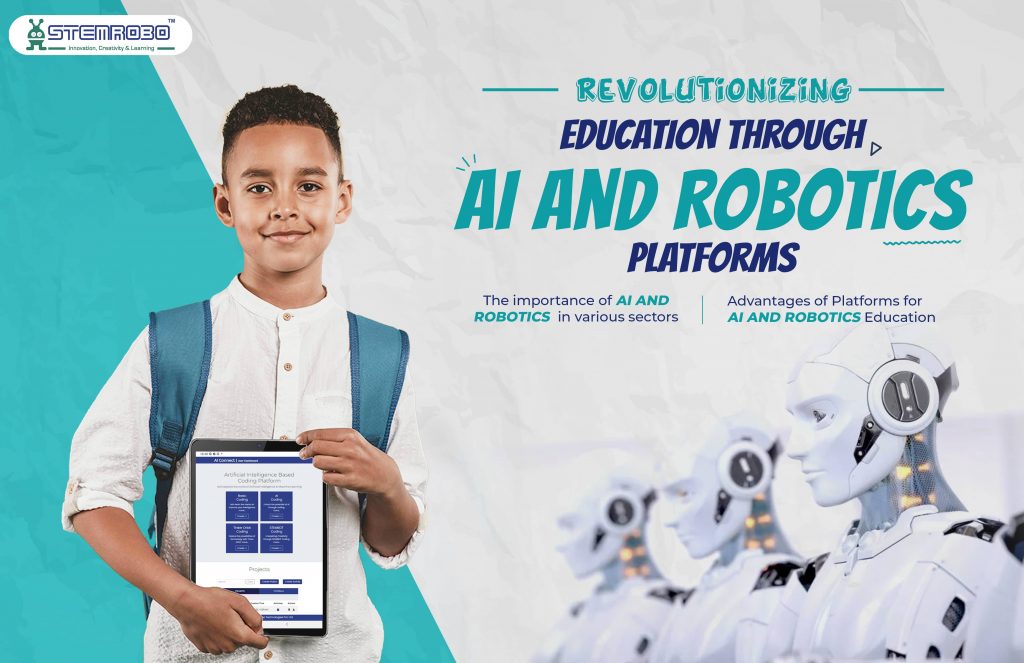
Revolutionizing Education through AI and Robotics platforms

In Today’s Tech-driven world, theoretical knowledge is insufficient for students to succeed in this quickly developing world. For Students, the importance of gaining knowledge related to technology is increasing and AI and Robotics are the most emerging fields among all. What is AI and Robotics? Robotics include studies related to the design of any robot through which children learn everything about electronic machines that we use in our day-to-day lives as well as in big industries. Through robotics, we learn how machines are made, their structure, design, and operation. Whereas AI (artificial intelligence) makes our machines work smartly. In simple words, AI teaches computers how to think and learn like humans. It helps computers to sense pictures, text, and sounds and provide results according to the given input. The importance of AI and Robotics in various sectors With the help of AI, machines have become automated, these automated machines take less time to complete any work as compared to humans and are also capable of giving more accurate results than humans. That’s why, Nowadays the importance of the human workforce is decreasing a lot. AI has developed so much that with its help we can now interact directly with technology. Communications systems like Alexa, Siri, and Google Assistant are AI-driven technologies. These technologies can listen to us, understand our communication, and respond to us. In the Education sector, AI and robotics play an important role in developing 21st-century skills such as Critical thinking, problem-solving skills, and communication skill among students. It also provides practical methods to understand complex concepts of STEM (Science, Technology, engineering, and mathematics) subjects. Advantages of Platforms for AI and Robotics Education There are many platforms for AI and Robotics that are designed for k-12 students, that provide them with the AI and robotics curriculum, resources, and an engaging platform to learn about these emerging fields. These Platforms for AI and Robotics education offer students a personalized learning environment where they can study according to their speed of learning and level of understanding of the concept. These Platforms for AI and Robotics education provide students with Hands-on training, With the help of this, children will understand the concepts better and this practical application will make the study more interesting for them. It also offers students educational resources such as tutorials, videos, and lesson plans that also provide a way for teachers to include AI and robotics into their curriculum and classroom activities. As we all know, nowadays there is a lot of demand in companies for those people who have knowledge about AI and robotics and have done projects related to it. So, if you want your children to succeed in the future workforce then provide them with practical knowledge by introducing them to platforms for AI and Robotics education. These platforms provide students with the opportunity to collaborate with others, share their ideas on different projects, learn how to communicate with others, and how to work in a team effectively. Importance of platforms for AI and Robotics in Schools AI and robotics make learning STEM subjects interesting and engaging as they involve project work and different group activities through which students get a chance to think creatively and apply their ideas to create something new. These Platforms for AI and Robotics also provide great help to teachers in enhancing their teaching methods. Through lessons and videos teachers can learn many other different types of ways to explain a particular topic. They may use different teaching methods according to the individual needs of the student. Students will enjoy learning through platforms for AI and Robotics as when children understand everything well, they feel motivated all the time. Integrating platforms for AI and robotics into school curriculam offers many benefits. These platforms engage students in hands-on, project-based learning, fostering interest and deeper understanding of STEM subjects. Through creativity and innovation, students deal with real-world problems, developing critical thinking skills and preparing for the 21st century. Interdisciplinary learning is promoted as students draw connections between different subjects. Using  platforms for learning Robotics and AI teachers also get the opportunity to enhance their teaching techniques and stay ahead in this technological world. For 21st century kids, who are different in each aspects and have interest in different subjects or skills, personalized learning experiences is very necessary and cater to individual student needs, fostering inclusivity and creativity. Altogether, these platforms enhance the educational experience and make learning interesting and easily accessible for each student enrich the educational experience, equipping students with essential skills and knowledge for future success.

Revolutionizing Education through AI and Robotics platforms Read More »