
Step-by-Step Guide to Setting Up a STEM and Robotics Lab in Schools
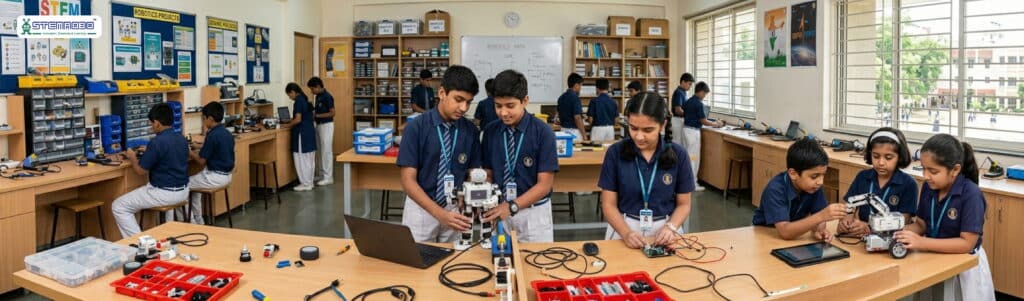
Today’s classrooms are not the lecture halls of the past. They are environments where students investigate, discover, question and construct. Today’s students don’t want to just read about science. They want to do science. They want to discover and design. They want to take the risks, make mistakes, analyze the results and learn from them. Let’s face it – this is the heart of the learning process. It is this change in perception and approach that is elevating the importance of the STEM and Robotics Labs within schools. For schools this is not simply a new space. It is a redesign and complete restructuring of the school itself. A thoughtfully designed STEM Lab converts the existing “listening rooms” into powerful learning centers where ideas are tested and the quest for knowledge flourishes. So, if you are thinking of introducing a STEM and Robotics Lab into your school, this guide will provide you with a roadmap for setting one up-clear and straightforward. Understand the “Why” Before the “How” Before you order any kits or begin establishing a laboratory, pause and consider; why does your school require this? The role of a STEM lab isn’t only about robots and coding. It’s about equipping students with the knowledge and skills that they will need for the future which will be integrated with technology, automation and problem-solving at an everyday level. As a result, early implementation of STEM learning in schools brings: A marked difference will begin to appear in your students, and not only in the marks they receive, but also in the attitude they approach learning with. Once the aim is stated it will become much more of a consequence of what you do next. Step 1: Define Your Vision Clearly Success starts with being clear. It is far too easy to have fantastic tools sitting in storage. Begin by thinking of these few, simple questions: The key for elementary classes (1-5) is invention, logic, and very simple physical models. As you move toward middle school students, you might introduce: Being clear on your goals allows you to purchase the right tools, not just more tools. Step 2: Create a Space That Inspires Learning You do not require a costly and complicated set-up to build up a STEM lab. Consider this more as a workshop than a classroom. The optimal space should feature: As students enter the lab they should experience an atmosphere where thinking and discussing ideas and testing solutions is encouraged and explored. Step 3: Choose the Right Tools and Kits Here is the point where most schools get stuck- and quite understandably so! There is a multitude of options out there in the market, and a majority of them are not meant for structured learning. Instead of picking a random kit or two, schools should look for solutions that are: This is where a truly integrated provider such as STEMROBO Technologies comes to the fore. Instead of piecing together kits, content and manuals individually, the schools can have access to an entire ecosystem that functions in tandem to one another! This ultimately saves time, and avoids confusion, while guaranteeing learning instead of simple play. Step 4: Don’t Skip the Curriculum One of the big mistakes that schools make is setting up a Robotics lab, but without the learning process being properly planned. The consequence is that students love the class, but the learning is fragmented. An effective curriculum should have include: A real-world example is a student building a working model which they then figure out how to construct – the experience has made the knowledge more memorable than reading about it in a textbook. Step 5: Train and Support Your Teachers However good your lab may be, it will be unsuccessful if your teachers are unhappy working in it. The upside? You don’t need to be a robotics expert to be a successful robotics teacher. They just need: Many schools partner with organizations like STEMROBO Technologies because they provide structured teacher training along with the lab setup. And once teachers are at ease, fantastic things occur – engagement increases, sessions are more fluid and the learning is more effective. Step 6: Focus on Learning by Doing This is without a doubt the most important component of any STEM lab. Have your students… Even if it is nothing more than an ill-constructed assembly of items when they first attempt to assemble it, that triumphant moment of seeing their contraption move and zip across the table after it is “fixed” cannot be topped for student confidence. That is what a hands-on lab can and must create. This is the magic of hands-on experiences. Step 7: Keep It Fun, Engaging, and Ongoing Your STEM lab should never feel like another class you have to go to. Instead, it should be something students look forward to! The interest and excitement can be sustained by: When the learning is enjoyable, students naturally increase participation and desire to learn more. Step 8: Take a Smart, Integrated Approach Establishing a STEM lab, however, is far from a simple task due to the numerous components involved. But managing each of these separately can prove to be tedious. Hence an integrated solution has become the preference for most schools these days. Schools that team up with partners such as STEMROBO Technologies receive: This way, it becomes both feasible and manageable to manage the lab for a long period of time. Step 9: Evolve with Time Once your STEM lab is up and running, the journey doesn’t stop—it actually begins. To keep it effective: Technology is ever evolving – your lab should be too. Final Thoughts Establishing a STEM and Robotics lab isn’t solely about providing the infrastructure, it’s about establishing the culture of curiosity, creativity, and innovation. It’s about shifting from: Schools that embrace this change are not just improving education—they are preparing students for the real world. Because in the end, the goal isn’t just to teach students how to use technology… It’s to empower them
Step-by-Step Guide to Setting Up a STEM and Robotics Lab in Schools Read More »