
Click For Schools

robotics and AI curriculum

How Early Exposure to AI and Robotics Sparks a Passion for Medicine

Building Future Doctors Through STEM: How Early Exposure to AI and Robotics Sparks a Passion for Medicine

You have noticed how doctors use huge and complex machines to examine and check patients. How blood tests and X-Rays detect any abnormalities. This helps in early disease detection and saves lives. And if you want to grow up a be a life saver then Robotics and AI will help you achieve your dreams with much ease. And Stemrobo is one of the biggest Robotics and artificial intelligence companies in India. 1. The World of Modern Medicine :Where Science Meets Technology Medicines and healing ointments only consistent of herbal remedies, and or plant extracts etc. Then it progressed more to inventions and discoveries that helped people get better and more efficiently. Then comes invention of plastic surgery by Sushruta, discoveries like penicillin to end infectious bacteria. The list goes on and will go on. 2. How AI and Robotics Help DoctorsAI and Robotics sounds very difficult but actually it is very easy to understand. Artificial Intelligence means training a computer to think and understand like a human and also react like one. And robotics helps a machine work or do work. So, when doctors know the benefits of AI and Robotics, they can use it to create inventions that would help patients recover quicker. 3. What If You Could Build One Too?Imagine that you see a medical instrument for the first time and how it helps detect illness. It is interesting to see this technology helps save lives. The questions of “how did this machine work?”, “how did they test the symptoms?” etc keep circling the mind.This strikes of curiosity are what motivates a student to work hard and achieve their dreams.Learning Robotics and AI helps a child understand how machines work and this in turn helps them come up with better solutions that are both easy and accessible. 4. The Power of Early ExposureWhen you start learning about STEM at a young age, something magical happens. You then become more aware and start associating everything to science. This is where Robotics and AI curriculum becomes important for schools• thermometer? – how does the mercury define temperature?• MRI – how do they take images?• how do blood test work?This curiosity is the best way become an innovator. 5. Real Examples of STEM in MedicineLet’s see how STEM is helping doctors around the world right now:1. Robotic Surgery:Robots like da Vinci Surgical System help doctors perform complex surgeries with high precision. The robot’s tiny arms can reach places human hands can’t.2. AI in Scanning:AI can scan MRI or X-ray images in seconds and point out even tiny problems. It saves time and reduces human error.3. 3D Printing:Using engineering and technology, doctors can now print artificial bones or organs using 3D printers!4. Smart Wearables:Watches and bands that measure heartbeats or sleep patterns are made with sensors and coding. They help doctors monitor patients from far away.5. Virtual Reality (VR):Medical students use VR to understand how human body and other organism work. This is a very big conservation move.6. How STEMROBO Makes It Fun and EasyWe make the learning process very easy for students. The teachers are also trained well so that they can guide the students properly and solve their doubts. We create special curriculum which also follows the NEP2020, and this curriculum makes sure that no student is left with a doubt. And that every student is comfortable with the lessons and actually has fun learning and creating technology. These students learn how to create their own robots and fix them. They also learn how to make better decisions and communicate better. They are also encouraged for project on artificial intelligence for school students 7. How Learning STEM Builds Doctor-Like SkillsJust with knowledge and a degree, doesn’t make you a doctor. You will need the essential 21st century skills that makes you have an attractive personality. This will ensure that your future patients are comfortable with you.Here’s how:• When you code a robot, you learn patience and logic.• When you design a project, you learn creativity and precision.• When you work in a project, you learn about various 21st century skills that are very important, like collaboration.• You also learn the skill of never giving up, to keep trying till you get success.These are not just school skills. They are life skills that help you in every career especially medicine. 8. The Future of Medicine Belongs to InnovatorsThe future belongs to the people who are skilled and passionate. Now, robots are helping in doing surgeries with much focus and precision. Who knows what is the next big invention in the field of medicine 9. How Parents Can SupportTo build future doctors, schools and parents must encourage curiosity.Here’s how:Parents are the biggest supporters of a student throughout their STEM journey. They can ask their kids to explain them certain simple topics, ask them what project they are working on etc.10. How STEMROBO Helps Build Future InnovatorsThis company helps to make education easy, fun and accessible to all. Not only the big cities but also even the tier 2 and tier 3 cities. Because education is for all and no child should be left behind in achieving their dreams 11. The Message for Every Young LearnerIf you dream of becoming a doctor who helps people get better and contribute to the society, then it is very important that you know that it requires hard work to get the name Doctor before your name. Because doctors heal people and along with that, they also create machines and medicines that help the society. The world is changing as fast as the technology is changing with speed, everyday. That is why STEM education with Science, Technology, Engineering and Maths, helps students get used to their surrounding quickly and master the requirements that are required for future jobs.
Building Future Doctors Through STEM: How Early Exposure to AI and Robotics Sparks a Passion for Medicine Read More »

The Growing Importance of Robotics for Kids in Modern Education

The Growing Importance of Robotics for Kids in Modern Education

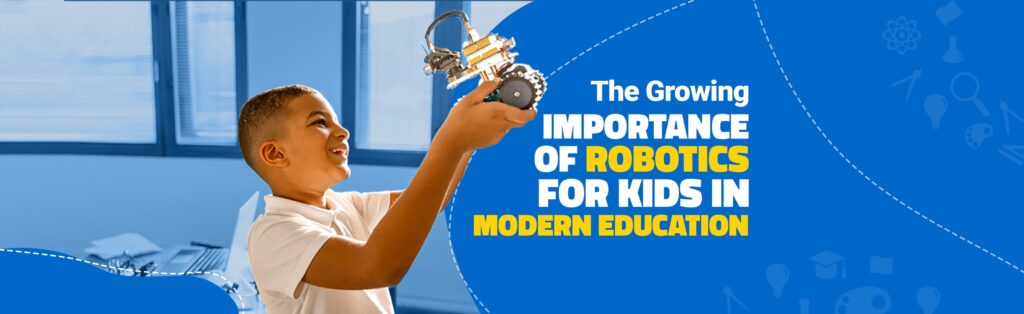
What are robots and robotics? Robots are physical machines that perform tasks to ease the life of humans and robotics is the field of study that designs, invents and programs. It combines the concept of science, mathematics, technology, engineering, i.e, STEM and also AI, to develop unique robots to make our lives easier With the advancement of time and technology, we are leaning more towards the comfort that the presence of robots provide. From the time we get up, scroll our phones to the time we head back to our beds, we are subconsciously surrounded by robots at every second second of our day. If we want to prepare kids for this future, we need to rethink how we teach them. Traditional education has served us well, but it’s no longer enough. Kids today need more than just books and tests. They need to learn how to think critically, solve problems, and create. And this is exactly where robotics education comes into play. Imagine a classroom where students aren’t just memorizing equations or listening to lectures. Instead, they’re building and programming their own robots — learning through action, collaboration, and real-world problem-solving. This isn’t a futuristic fantasy. It’s happening now, and it’s changing the game for education. Atal Tinkering Labs (ATLs) are government-initiated innovation spaces in schools, designed to foster creativity and hands-on learning in STEM fields like robotics, coding, and electronics. These AI and Robotics labs, part of the Atal Innovation Mission, aim to develop problem-solving skills and prepare students for a technology-driven future and provide Robotics labs for schools.  Let’s explore how robotics is empowering kids to become the leaders, innovators, and problem-solvers of tomorrow. FROM THOUGHTS TO THINGS Traditional classrooms are often only equipped with the blackboard and the teacher who most probably fails to engage the whole of the class . In today’s fast-paced, tech-driven world, where competition is getting more tense, simply just going for class and doing homeworks just doesn’t work well. Students need dynamic, hands-on education that prepares them for the rapidly evolving world of technology and innovation. This is where robotics education comes into play Traditional classrooms are designed around a passive learning model, where students listen to a teacher and absorb information. But this approach doesn’t always translate well in today’s fast-paced, tech-driven world. The future demands that kids don’t just absorb knowledge — they need to actively apply it. This is where robotics and coding for kids steps in. What is Hands – on learning? Robotics and AI Curriculum for schools is a game-changer because it turns students from passive learners into active creators. Instead of just learning about how things work, kids get the chance to roll up their sleeves and actually build something that works. Imagine a group of students sitting together, coding a robot to move or figuring out how to fix a broken sensor. They aren’t just memorizing facts — they’re problem-solving in real time, trying new ideas, failing, and then trying again. This develops their resilience and their persistence. They get ready for challenges ahead of them and to enjoy also the journey and embrace their failures with full heart and mind This type of hands-on, project-based learning is engaging, exciting, and — most importantly — memorable. Kids don’t forget what they’ve built and the challenges they’ve overcome. Robotics gives them a tangible way to apply everything they learn in school to create something meaningful. That’s the beauty of robotics — it makes abstract concepts real Problem-Solving and Innovation: The Heart of Robotics Education What makes robotics education truly special is the way it nurtures problem-solving skills. In robotics, there’s no one-size-fits-all solution. Every design is unique, and every robot faces different challenges. That’s why students must become innovative thinkers. They need to come up with creative ways to solve problems. Let’s say a student is building a robot to follow a path. At first, the robot works fine — but then it starts veering off course. The student quickly learns that the sensors need recalibration or that a different algorithm might be needed to guide the robot more accurately. This is real-world problem-solving in action. Robotics teaches students that problems aren’t obstacles, they’re opportunities to learn and improve. The more challenges a student faces, the more creative they become. And here’s the thing: innovation is contagious. As kids work together on their robots, they feed off each other’s creativity and learn how to tackle challenges in new ways.  They begin to see obstacles as chances to innovate — a mindset that will serve them well in any career, whether they go into technology, business, or any other field. Shaping the Innovators of Tomorrow It’s not just about building robots — it’s about building future innovators. The world is evolving at an unprecedented pace, and the next generation of leaders will need to be comfortable with change, creativity, and adaptability. Robotics education provides the perfect environment for kids to develop these traits. Think about the next big breakthroughs in fields like artificial intelligence, healthcare, or environmental sustainability. Many of these breakthroughs will be driven by kids who are learning robotics today. They might not realize it yet, but the students designing their first robot today could very well be the engineers, scientists, and entrepreneurs solving the world’s biggest problems in the future. Robotics: More Than Just STEM It’s easy to think of robotics as a STEM subject (Science, Technology, Engineering, and Mathematics). And yes, robotics teaches kids about coding, engineering, and algorithms. But it’s so much more than that. Robotics also fosters creativity, collaboration, and emotional intelligence. These are the qualities that will drive success in tomorrow’s world. Take teamwork, for example. Most robotics and AI projects require students to work together in small groups. They need to communicate, delegate tasks, and combine their skills to get the job done. In the process, they learn how to listen to each other’s ideas, provide constructive feedback, and resolve conflicts. These skills are just as important

The Growing Importance of Robotics for Kids in Modern Education Read More »

Robotics Lab for School Students

The Benefits of a Robotics Lab for School Students

Integration of technology has become important in the ever-changing educational sector as it promotes creativity and gets students ready for the employment of the future. Robotics is one of the most emerging fields that must be included in every school’s academic curriculum. In today’s tech-driven educational environment, there is an increasing need for students with technical abilities like robotics. Since robotics labs encourage hands-on learning, integrating them into classrooms is one method to support students’ educational journeys and get them ready for the employment market of the future. As it develops an excitement for learning about STEM (science, technology, engineering, and mathematics) subjects. Additionally, it makes their educational journey extremely interesting and filled with experiential learning. Hands-on learning Robotics labs are the platform that offers lots of opportunities for students to apply their creative ideas to real-world projects. Making these projects and involving in robotics activities, allows them to get an in-depth knowledge of any particular concept. By doing hands-on activities students will be able to retain the knowledge for a longer time and if the projects fail to work then they will be able to find their mistake at that time only and there they can also correct it. Fosters 21st-Century skills It develops 21st-century skills such as Critical thinking, logical reasoning, innovative and creative skills, communication skills, and teamwork. For example, when a student applies scientific ideas to a project, such as building a toy car, and if it doesn’t move, they can determine that there is a problem. It might be that the power source isn’t strong enough to drive the object, or the connections are incorrect. Thus, they will use their logical and critical thinking skills to solve this problem, which will also help them become more innovative thinkers and spark their curiosity in doing so. This will make their learning process engaging and make studying fun rather than boring because they will only be reading books. When students participate in these group activities, they can work together develop teamwork skills, and improve their communication skills. Additionally, when given project deadlines, they will learn time management skills. Finally, by working as a team, students can analyze each other’s performance and use this knowledge to improve themselves. STEMROBO is at the forefront of providing end-to-end solutions to K-12 students by integrating Robotics labs, STEM labs, AI, and many more labs. Our mission is to provide students with an interactive learning platform where students can practice Hands-on learning and develop their creative skills. Let us see how we accomplish this end-to-end solution approach. In addition to setting up these Robotics lab in many schools, we also give students access to a variety of kits that contain all the parts and equipment they could need for this hands-on learning experience. Along with this, we also provide teachers with a training program so they may learn how to utilize the labs and kits efficiently to improve student learning. Also, we organize national and international robotics competitions and offer workshops to students so they can first understand the significance of robotics labs for schools  and skills in their academic curriculum and second, understand the connection between theoretical knowledge and practical applications. Our lab for AI and robotics is a special place where students can explore the connections between these two revolutionary technologies. We provide schools with a comprehensive robotics and AI curriculum that gives students the information and abilities they need to succeed in the digital era. Our school robotics program is thoughtfully developed to meet the unique requirements of children at various stages while still following academic standards. We offer a dynamic learning environment where students may explore, collaborate, and invent through our student robotics lab. Our organization, AI and Robotics Lab in Schools is committed to utilizing innovative technologies to impact the field of education in the future. We think that robots and artificial intelligence (AI) have the potential to transform education and prepare students for the challenges of the future.

The Benefits of a Robotics Lab for School Students Read More »