How Robotics Labs Are Transforming K-12 Education in India
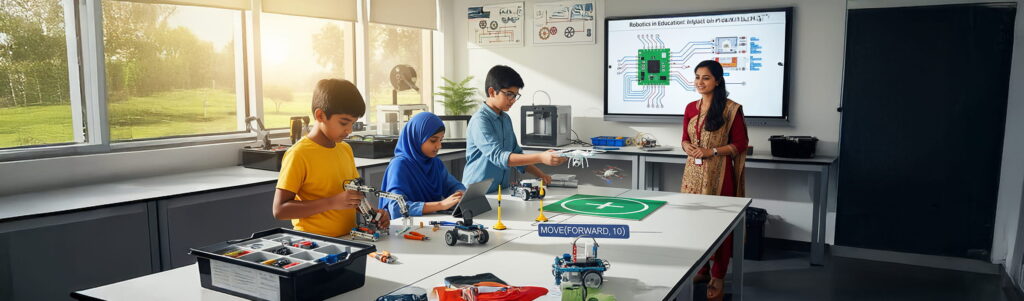
India’s education landscape is evolving at a rapid pace , fueled by technology, innovation, and the growing need to equip students for a future unlike anything before. Today, students have unlimited access to resources that help them enhance their knowledge, sharpen their skills, and develop deeper curiosity. Now Students have unlimited access where they can enhance their Skills, knowledge power , sharpen their skills and develop a deeper curiosity for learning. The classrooms are evolving beyond textbooks and tests into spaces filled with creativity, technology, and active learning. AI & Robotics Labs are leading this shift, giving students the huge opportunity to explore, build, and help them to develop problem solving skills . As a core part of STEM education, these labs are helping schools create learning experiences that focus on curiosity, and real-world application so that students can learn hands- on activities. Robotics lab are no longer limited to elite institutions or higher education. Today, they are becoming a one stop end to end solution for new age schools, especially in the K-12 segment, helping students to , nurturing creativity, experimentation and developing 21st century skills for students and teachers. These labs act as creative learning hubs encouraging curiosity, and learning becomes practical , interactive and engaging. With a young population and rapidly fast evolving tech ecosystem, it needs an education system that focuses on learning and innovation skills, design thinking solutions, and hand on application. Students go beyond exam- centric learning and develop skills that are aligned with future career opportunities in technology-driven fields . Robotics labs play a key role in bridging the gap between theory and real-world application. They introduce students to coding and AI platforms for schools, robotics, automation, and even emerging areas like AI & IoT lab setup, AR / VR lab setup, and Atal Tinkering Labs in schools making learning more relevant and future-ready. What we are seeing today is not just a change in classrooms, but a move toward future-ready learners and a more innovative, adaptable education system in India. What Is a Robotics Lab in K-12 Education? Robotics labs turn ordinary classrooms into lively STEM hubs where ideas are not just only discussed, they come to meet action and provide them results as well . By combining all hardware, software, and structured curriculum, these labs give freedom to all the students to explore robotics, coding, AI, and problem-solving through practical projects rather than just reading the theories and making the experiments from the textbooks. Whether it’s a basic robotics lab for junior level students or an advanced AI and Robotics Lab in senior classes, these systems support all the age groups from the K-12. Students don’t just learn how these robots work, they acquire knowledge about design, build, test, iterate, and innovate, gaining practical skills along the way. This adds excitement in the students while keeping them focused and engaged. Alignment with NEP 2020 and Competency-Based Learning The National Education Policy (NEP) 2020 plays the vital importance of experimental study , multidisciplinary education, critical thinking, and skill development from a junior age group of students. Robotics labs strongly support these goals by promoting learning by doing rather than memorizing the theoretical concepts from the books. Through project-based activities, students build strong skills such as Problem analysis, Original thinking, Cooperative learning, and Practical reasoning. Robotics encourages learning practical knowledge , where students are judged on how well they grasp and apply concepts, not only on exam results. In addition to robotics labs, programs like Atal Tinkering Labs (ATL) and AR/VR-based learning environments play an important role in building up NEP 2020 implementation in schools. ATL encourages New-age solutions, Empathy-driven design, and Activity-based problem-solving by enabling students to experiment and build real-world solutions. AR and VR technologies enhance robotics learning by allowing all the students to understand the complex concepts , explore virtual worlds , and interactive learning . Together, robotics labs, ATL initiatives, and AR/VR tools contribute to learning environments that support NEP 2020 goals. Why Robotics Labs Are Crucial for 21st Century Learning Traditional education focuses on rote learning while Robotics labs shift the focus to doing and experimenting. Through STEM education for students, learners develop skills such as critical thinking, creativity, teamwork, collaboration, and logical reasoning. These labs encourage stem based learning, helping students understand concepts of math, science, coding and technology in a practical way. They‘re preparing the students for 21st century skills which help them to navigate their careers paths. Robotics Labs and Coding: Building Digital Fluency Early Coding has become an essential skill for students of all ages. Robotics labs bring together robotics and AI learning, offering age-appropriate coding platforms for all the students. Students can start with learning block-based coding in early grades and gradually progress to Python, AI models, and automation in higher grades. This structured approach ensures continuity across K-12 and supports an end-to-end solution for K-12 school learning providing a comprehensive solution for school STEM education. AI, IoT, and Future Technologies in School Labs Modern robotics labs are much more than a place for building robots. Schools now adopt AI & IoT lab for schools, AI lab setup in schools, and IoT lab for kids to expose students to smart technologies and prepare them for the emerging tech careers. Here they learn how the sensors detect information , how data is gathered, and how smart systems make decisions. By working straight with these technologies students find confidence in themselves which inspires them to pursue careers in Robotics, AI emerging tech industries in India. Industry-Relevant Skills and Career Readiness Robotics labs give students hands- on experiences that are directly useful in today’s industries as it’ll help them for their future career aspects too like entering in the engineering, data science, automation, and entrepreneurship field . By participating in the project-based activities, students learn how technology is actually applied in real-world application of technology . This experience builds both self assurance and capabilities to expand their career awareness for higher education and professional growth.
How Robotics Labs Are Transforming K-12 Education in India Read More »